Journey to the Joy of Birds: An Interview with Kevin McGowan
Crows, Curiosity, and Communicating Science
At every step, I had to choose: this path might pay more, but that one lets me keep thinking about birds. And I kept choosing birds. I get to think about birds every day—and get paid for it. And that’s awesome.”
Twenty-five years ago, Kevin leaned over a crow’s nest, camera in hand, and snapped what might be the first crow research selfie on the internet—one fledgling mid-squawk, his face half-framed by twigs. The birds were part of a long-term study he’d been conducting for years, and the photo ended up on his website alongside early field notes and a growing list of crow FAQs.
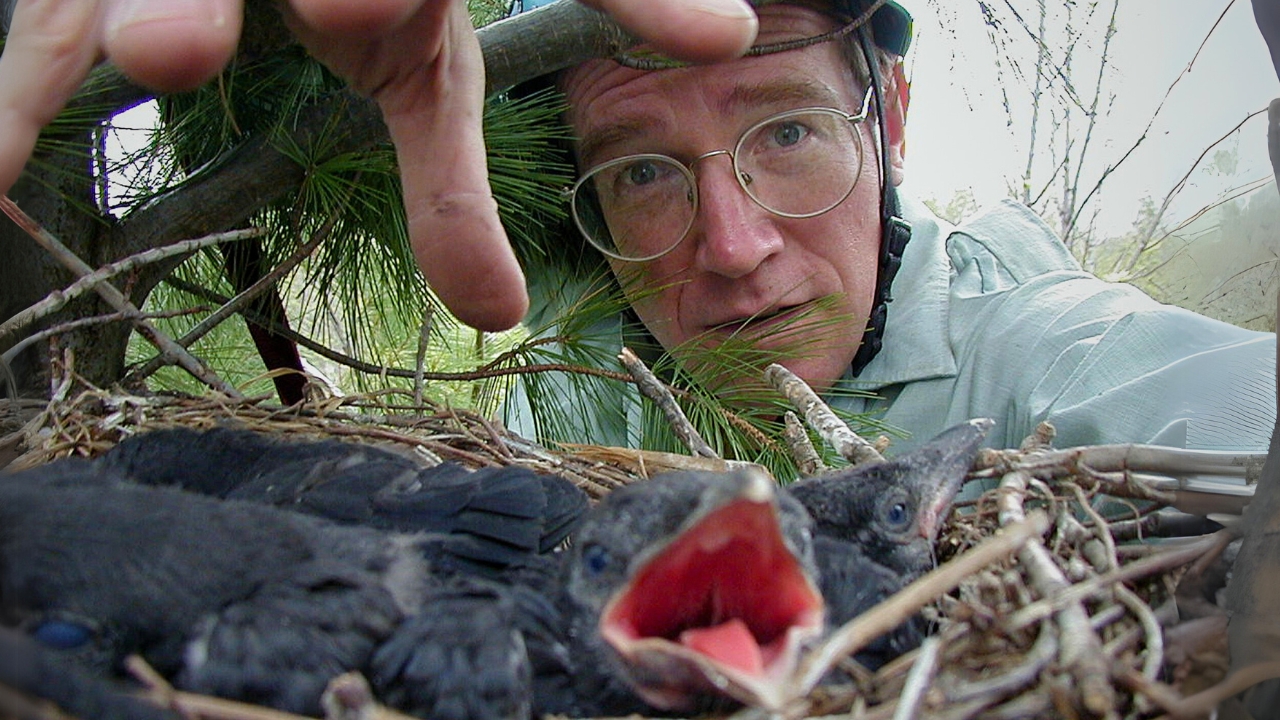
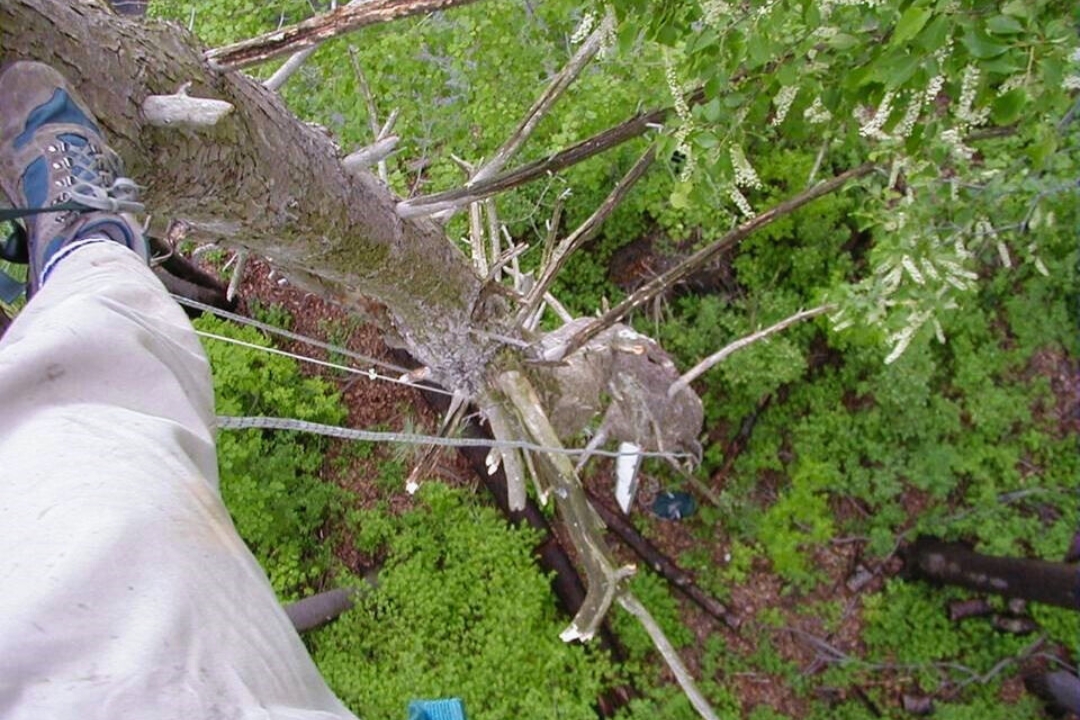
Climbing trees became a way of life and many of his ascents were simply breathtaking. “I’d be climbing a tree in someone’s backyard in Cayuga Heights [in Ithaca, New York], nothing out of the ordinary. But I’d reach the nest and suddenly I could see the lake! Some of the most beautiful views of Ithaca I’ve ever seen were from the tops of those white pines. I started taking pictures from the nests. Crows like to nest in white pines that rise above the canopy—not in it, but over it—so they can see a long way. They like a good view.”
“Some moments made me smile, others made me cringe,” he said. One of the most terrifying moments came at the top of a big white pine on the Plantations Knoll of Cornell campus. “A wind gust hit, and the tree didn’t straighten back up. I just had a flash of that bright white splintered wood you see when a pine breaks. That was it—I measured the nestlings’ heads and got out.”

Kevin’s Journey to the Cornell Lab
From climbing pines to course design, Kevin’s career choices have been intentional. After grad school, Kevin McGowan set his sights on a faculty job. “I wanted to teach and do research at a major university,” he said. “But it didn’t work out. Almost nobody in my cohort got the jobs we expected.”
He started at Cornell University, working a position in charge of the bird and mammal collections in the Department of Ecology and Systematics (now known as Ecology and Evolutionary Biology), then based out by the Ithaca airport. Although he was far from students, he was still immersed in birds. When the internet began to take off, he saw an opportunity to get involved in teaching again.
“I started putting up pages about my crow research because I kept getting the same questions over and over,” he told me. “So I thought—why don’t I just throw this out there?” It worked. Once he could include photos, he began building out pages for the collections, highlighting unique specimens and using imagery to help people connect. “I realized that was a great way to spread the word,” he said.
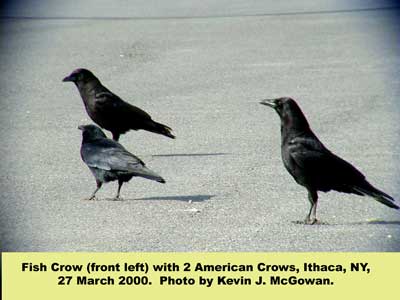
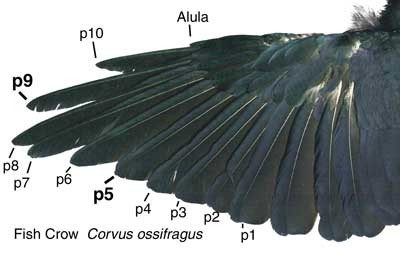
During our conversation, I mentioned that’s exactly how I first came across his work. “I was looking up questions about crows, and your website popped up. The FAQ page was like a gold mine.” Kevin laughed. “I wrote those FAQs 30 years ago.” “Yeah,” I said. “It looks like it.” He grinned. “Yep. But that’s when I started being able to do that kind of stuff. I wanted to get the information out there.” Below are photos from Dr. McGowan’s original website describing differences between Fish Crows and American Crows.



In the Company of Crows
When Kevin McGowan began his long-term crow research, he didn’t expect their lives to feel so familiar. Over time, he uncovered a complex, tightly knit world: families of 15 birds, with offspring from five different years all living together. Kevin is wary of anthropomorphism—scientists are trained to be. But studying crows made it hard to ignore the parallels. “I’ve always avoided that,” he said. “But then you end up with a bird and think, geez… this is just like people.” One mated crow pair even adopted a chick from a neighboring territory. “I think they just had so many birds that it was like—well, one more’s not a big deal,” he said laughing. “That family had around 11 adults and 4 dependent juveniles. One of the neighbor’s kids must’ve wandered over, and they just started feeding it.”
In Ithaca, he observed crows forming suburban-style neighborhoods. He noted that crows “own” and defend territory, stick together as a family, and recognize other crows by call.
Outside their territories, crows also gather in larger social groups—fleeting, fluid communities, like people at the beach or in a shopping mall. “I studied winter foraging flocks,” he said. “There’d be 200 crows in a field every day, but it wasn’t the same 200. Only a handful showed up regularly. The rest came and went—just like a mall. A few people are always there, but the crowd constantly shifts.”
From All About Birds to Bird Academy
Over time, Kevin’s role shifted as the collections became part of the Cornell Lab of Ornithology. Eventually, he moved from the collections into more public-facing projects, when he joined the team that launched the original All About Birds website in the early 2000s. “I took over the writing of the bird guide, which was the majority of the site at that point,” he said. “When we hit a million hits—that felt huge.”


Later, he moved from webpages to course design—initially creating the Lab’s first online course, a five-week bird behavior course. But the structure was demanding. “It took fifteen hours a week just to keep it going,” he said. Looking for more flexibility, he shifted to webinars which were live, interactive, and a better fit. The webinars eventually evolved into Bird Academy’s first self-paced courses. Size and Shape and Color and Pattern marked a turning point. “Those [courses] were mine from the ground up,” he said. “The concepts, the writing, the exercises. That was my story.”
From there, things took off: courses, webinars, collaborations, and eventually Bird Academy. “It’s been fun,” he said. “Just being able to reach more people, and do it in a way that makes the science accessible.”
The Key to Good Science Communication
People can handle complexity,” he said. “But only if you meet them where they are.”
Kevin McGowan was trained to communicate like a scientist. “When you get a PhD, you’re basically taught to talk technically with each other,” he said. “And it makes you specific—but also absolutely impenetrable to the rest of the world.” This tension between clarity and expertise came up again and again during our conversation.
He talked about early conference presentations that stayed with him—not for what they said, but for how they said it. “Some of the most interesting research I’d ever seen just didn’t land because of how it was presented,” he said. “Meanwhile, other talks left a big impression—but didn’t really say much.”
I asked him what he took from that. “It doesn’t matter what you say,” he said. “It matters what they hear. And if they don’t hear it, then you didn’t get your point across.” When Kevin is developing courses for Bird Academy, his goal isn’t to oversimplify—it’s to make learning feel possible.
Check Out Kevin’s Most Recent Course!
Photos by Kevin McGowan unless otherwise stated.