Joy of Birdwatching
Welcome to birdwatching! Get all the tools, tips, and inspiration you need to get started.
$39.99
Samantha: Hello everybody. Welcome to today’s webinar. Excited to see everyone here today. Well, why don’t we get started with a brief schedule of today’s program here today. First, we will introduce Kevin McGowan and talk about the video, what it is, and how it came to be. Then we will all watch the video premiere of the walk together, followed by a live Q&A session where we can address both pre-submitted questions and some in the chat.
Lastly, we will end with our thank-yous and farewells. I’m going to introduce you to Kevin in just a moment. But first we have a couple announcements. Today’s webinar is hosted from Ithaca, New York, where both Cornell University and the Cornell Lab of Ornithology are located. It is important to recognize the original stewards of this land, the peoples who had a historical and continued connection to this place, and the traditional ecological knowledge held and shared from these communities.
Please stay with me as I read a brief statement acknowledging and made in collaboration with the indigenous people of this area. Cornell University is located on the traditional homelands of the Gayogo̱hó:nǫɁ (the Cayuga Nation). The Gayogo̱hó:nǫɁ are members of the Haudenosaunee Confederacy, an alliance of six sovereign Nations with a historic and contemporary presence on this land. The Confederacy precedes the establishment of Cornell University, New York state, and the United States of America.
We acknowledge the painful history of Gayogo̱hó:nǫɁ dispossession, and honor the ongoing connection of Gayogo̱hó:nǫɁ people, past and present, to these lands and waters.
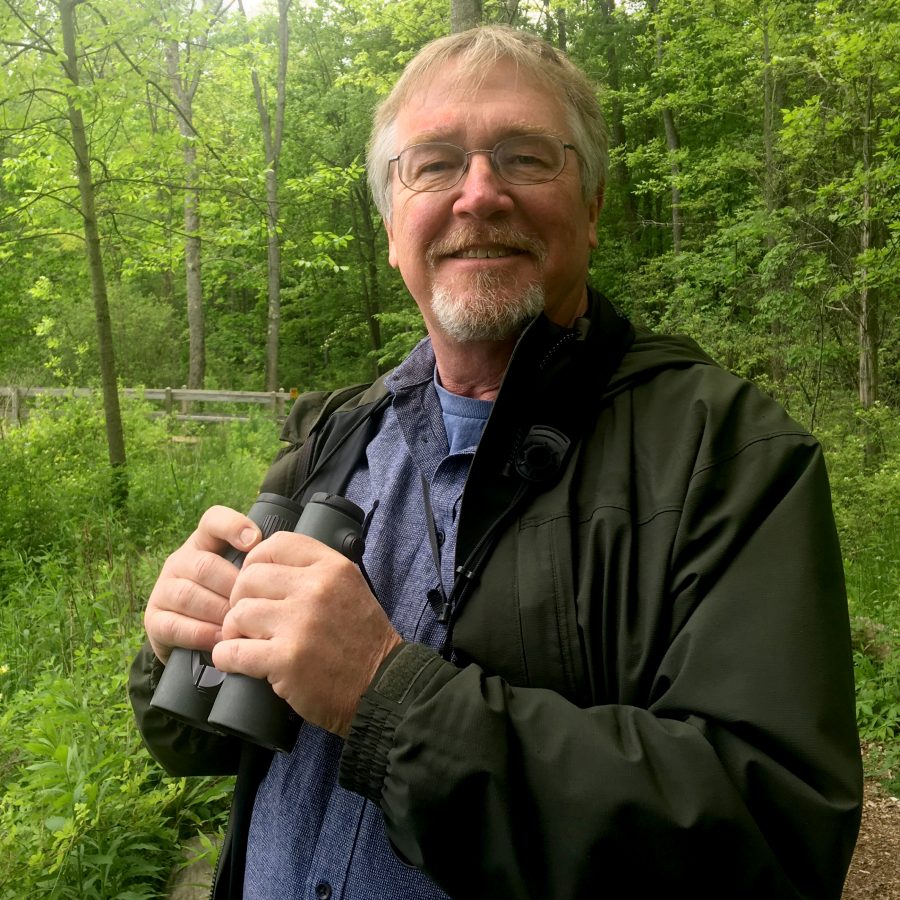
With us today is Dr. Kevin McGowan. Kevin is a professional ornithologist and avid birder. He is the author and instructor for many of the Bird Academy courses, including the Be a Better Birder: Warbler Identification course. Kevin was the coeditor and primary author for the book The Second Atlas of Breeding Birds in New York State, one of the creators of Cornell Lab’s All About Birds website, and the former curator of the bird and mammal collections at the Cornell University Museum of Vertebrates. Kevin enjoys all aspects of birds—especially crows—from behavior to functional anatomy and from ecology to evolution.
He is interested in spreading the appreciation of birds to all possible audiences through all possible avenues. Kevin, why don’t you say hello?
Kevin: Hi, I’m Kevin McGowan. Welcome, everybody.
Samantha: Kevin, I heard that you recently celebrated a birthday.
Kevin: Yeah, that’s true. Just this week, and as has become tradition, I saw my first Blackpoll Warbler of the year on that day. It’s kind of the second end of the second wave of neotropical migrants coming through that just happens to coincide with my birthday, so that’s always fun.
Samantha: That is a great birthday warbler, and I hope everyone is wishing you a happy birthday in the comments—join me. Great. I’m glad. Okay, so we are so excited to see this video together. Do you mind giving folks an introduction to the video? What we are about to watch?
Kevin: Sure. One of the things about living and working in Ithaca is that the property of the Lab is just gorgeous, and the area around is beautiful. We’re in the beautiful Finger Lakes region of New York State. And as I say, one of the big things I like about working physically at the Lab, despite…in addition to the fact that the parking is easy—not like on campus—but we have this, we’re in a sanctuary, and the woods is beautiful and we can just walk out the door at lunchtime and take a walk and get some green and see some birds.
And so I’ve been doing that every single day pretty much for the last ten years or so. And I always invite people to come with me and our Lab, our Bird Academy team has, it’s become a sort of a team effort, and we like walking out there and sharing the space and our experiences together. Find more birds too.
Samantha: Yeah, it is beautiful. And for this video, where are we going? This is a special one.
Kevin: This one’s a little different.
I have to say that the Lab of Ornithology, Sapsucker Woods is a gorgeous place, but it’s a little too noisy to do any filming. So we went to a local national forest and park. So this is a fun—it’s the Hammond Hill State Forest and the Roy Park North section.
owned by the local land trust.
Samantha: Yeah. Great. All right. So I would love for us to watch the video. Why don’t we get started? Chat, please bear with us as we switch over. We’ll watch the video together. Kevin and I and the moderator team will be in the chat as we watch. So feel free to keep asking questions as we watch. All right, let’s start.
Kevin: Thanks for joining me today. What we’re going to do is we’re going to walk through the forest here. We’ll walk for about a mile and a half, and we should find a nice mix of birds along the way. Let’s go see what we can find.
If you listen up here, there’s a bird doing an intermittent song. It’s a Red-eyed Vireo. Very common in eastern North American forests. The way it changes its intonation, it sounds like it asks a question, and then it answers that. And then ask a question, and then it answers that. So listen, see if you can hear that.
Frances: Yeah.
Kevin: [Mimics vireo]
And they always sound a little bit different, but they always do that pattern. So it’s easy enough to identify them.
We’ll hear more of those I think.
Oh! That’s probably a Red-eyed Vireo nest. Vireos make nests that they hang from a fork. Looks like a normal nest, except it’s hanging by two small branches. This looks like last year’s or something—it looks a little worn, but you can see that it’s attached to that fork.
So you can see we’re getting into some conifers now. These are eastern hemlocks. And for me, I always associate hemlocks with Black-throated Green Warblers. So if we listen, maybe we can turn one up around this little grove.
Did you hear it? Great. See, I’m not lying. [Samantha: Yeah, it was right on cue!] They really do like hemlocks.
Shayna: What should they sound like?
Kevin: If you’re listening, they do a buzzy. Their song is very buzzy. It’s like “zu-zee-zuzu-zee.” Or some people say it “sweet breeze in the trees.” But I think it sounds buzzy. That’s—I think “zu-zee.”
Nia: Everybody has their own way to remember the bird call, so it’s always interesting. Some stick more than others.
Kevin: Different mnemonics for different folks. All right. Move on?
There are several different ways to appreciate birds. Birders, sometimes they’re competitive, you know, they play the game—the birding golf, as we used to call it—where you have a list and you’re trying to get as many as possible and less concerned about things like robins. But then there are the other people who are, you know, just appreciate everybody. And that’s the thing about birds is there’s so many different ways to appreciate it, so many different levels.
It can give you challenges for your entire lifetime or just let you sit in an easy chair watching a feeder and enjoy the world.
Nia: Yeah, I was so sad when the robins were gone this winter. So now that I see them again during the spring—or at least the robins around me—I notice them a lot more and I appreciate them a lot more.
Kevin: That’s good. It’s good. Birds are a lens to look at the world. That’s sort of the way I feel about it is it’s an excuse to get out in the world and you can see things you couldn’t see. And so now the robins, for you, have made you more conscious of the seasons, right? Yeah. Things happen when the seasons change. Celebrate the return of the robins.
There’s a, there’s an eft. A little salamander here. [Nia: Oh that’s so cool!] See it?
This is a red eft. It’s one of the life stages of a eastern newt.
Nia: Oh, I didn’t know that.
Kevin: They start off as an aquatic form and then go into the hills like this and then come back as adults and breed.
Very pretty. Always fun to find.
Nick: Sapsucker.
Kevin: You saw or heard it?
Nick: I heard it, and then I saw it and it flew to the left here.
Sam: Oh, yeah. Come back. There’s like a little window.
Kevin: Oh, yeah.
Nice, nice.
Frances: It’s on the tree branches. And then it’s…
Kevin: …lower than you might expect.
Chelsea: Why are they called a sapsucker?
Kevin: Because they actually eat sap. They don’t suck it, but they make holes in the bark. And then the sap weeps out, and they lick it. All right, well, let’s walk out of the woods.
Isn’t this pretty?
Come out to the marsh here. The Red-winged Blackbirds and Yellow Warblers.
It’s a good place for a Tree Swallow if you can find a dead tree.
Swallow?
So the couple of things singing here. “Witchety-witchety-witchety” is a Common Yellowthroat. “Dee-dee-dee-didi-didi” is a song sparrow. And the other one? There are a couple of our Yellow Warblers. Very fast. “Sweet-sweet-sweet-I’m-a-sweet!”
Let’s move up so we can go look in the water.
Top of the snag is the Cedar Waxwing.
Cedar Waxwings eat a lot of fruit, but they also eat a lot of insects. And they do a lot of flycatching from here. So you’ll see them go off that sit up on a tall perch like that, and then fly out and grab a flying insect and come back to the same perch or something similar.
Waxwings are such a pretty bird.
Nick: Why are they called waxwings?
Kevin: They actually have wax on their wings that they form on the tips of some of their wing feathers, the adults, a little red wax, a red drop of wax.
Chelsea: Where do they migrate to?
Kevin: Well, it depends. If there’s fruit available, some will stay here all winter. We usually get some somewhere on the Christmas count on January 1st in upstate New York, which seems crazy, but there is, some years, some fruit crops that they can take advantage of. Otherwise they move south almost to Florida maybe, something like that.
There’s the kingfisher.
House Wren, singing right there. Yeah, well, I think that’s about it for the walk today. I want to thank you all for coming and I hope you had a good time.
All: Thank you.
Samantha: That was great. What do you think everyone? Did you like going on a walk with us?
Kevin: I hope so, I really love being able to share the beauty of Central New York and its birds.
Samantha: Yeah. It is always great to go walking with you, Kevin. Like, just like you said, it’s one of the best parts about working at the Lab, and it’s been amazing to share that magic with the audience here today. One of my favorite parts about going walking with you is getting to ask you as many questions as I can. It’s kind of like walking with my own personal guide, my own personal field guide.
So I hope you don’t mind, but we’ve prepared some questions for you from the audience.
Kevin: I’m happy to answer questions. I guess it’s kind of my lot in life these days.
Samantha: I know I’m probably one of the people who’s always asking you questions, too.
Kevin: It’s alright!
Samantha: So with hundreds of questions submitted, we tried to organize questions based on common theme. And then we’ll get to some live questions in a little bit. So, first up, why bird at noon? That was a common question we got asked.
Kevin: Yeah. Well that’s because people know that noon is not necessarily the best time of day for birds; that birds are most active in the morning, right in the very early morning is when you hear the most singing and birds are foraging after the night that they’ve been fasting…so, why noon? It’s because that’s the time we can and we take a lunch break at noon.
little call notes and things like that. And so listen for the birds and try to hone in on where they’re calling from. And one of the good things to do, too, is to go where the birds are. Find out about places that are near you. Look at eBird and look for birding hotspots in your area, and try to go someplace where you know other people are seeing birds or it’s a good habitat for the birds.
Samantha: Yeah, I totally agree. As a young mom, I would encourage people to get out as much as they can or when you can. All right. So the next theme that I saw were folks were feeling a bit overwhelmed where to start birding. So do you have any tips on how to start birding?
Kevin: Well first, yeah, take some of our courses! We’ve got courses for beginners in Bird Academy that can help you get started with that, with our birding by size and shape and color and pattern. Our Joy of Birding, or Joy of Birdwatching, and some of those other ones that can help you get started. But, I will tell you one tip that really helps.
Once you get into it, and you’ve been looking through the field guides and spending some time in the field, one of the best things to do is bird with other people who know things. We’re a social species, we don’t all have to learn it on our own, otherwise we’d still be banging the rocks together guys. So bird with other people.
And that often means—for me, that meant I got a membership in the local Audubon Society, and they had field trips. Clark County Audubon Society in Clark County, Ohio, and they were wonderful. The people there were knowledgeable. We had pretty non-stressful field trips that were a lot of fun. And I learned a lot because it really does—
It is hard to get out there and figure it all out on your own. So bird with somebody else and take our courses.
Samantha: Along the same theme. How do I find the birds?
Kevin: Well, the big deal is watch for movement, trying to see birds move. I mean, sometimes you can find birds that are sitting, you know, look for something that’s a perfectly upright thing instead of, you know, branches go off at an angle; but birds move, sometimes frustratingly so. But watch for movement. That’s a good thing. Also, listen. It helps if you can hear the birds because birds don’t just sing, they make other noises as well,
little call notes and things like that. And so listen for the birds and try to hone in on where they’re calling from. And one of the good things to do, too, is to go where the birds are. Find out about places that are that are near you. Look at eBird and look for birding hotspots in your area, and try to go someplace where you know other people are seeing birds or it’s a good habitat for the birds.
And indeed, forests can be frustrating, especially when the leaves come on the trees. You know, when the first warblers come back, it’s like, oh, they’re pretty, I can see ’em. And now the leaves are out and they’re covering their faces and make it a little, a little tougher. But yeah, just keep at it and, you know, watch for movement and enjoy the birds as you can.
Samantha: That’s great. All right. How about with color blindness? How do we deal with color blindness with birding?
Kevin: Well obviously if you can’t see some colors that hinders you a little bit. But there are other patterns that you can look at. You look for shape, size, shape, song, behavior, habitat, range. All of those things help you identify birds. But color is a thing. And that, for me is personal too, because I’m not completely colorblind, but I’m a little bit less sensitive to red than most people, and so it doesn’t pop out at me that when they’re there together.
And like for, I have a prime example, my first—would have been my life—Summer Tanager in southern Ohio, that I was with this group of birders in the Audubon Society, and we were south of where I lived. It just gets down into the hills and people were saying, “Oh, look, there’s the Summer Tanager.” And I’m like, where, where?
And, “Oh, it’s so pretty.” And it was in this tree. And it’s like, where in the tree is it, where? And I couldn’t see a thing. I couldn’t find it. And people were, everybody else seemed to get on it. And then it flew away and I saw this red thing fly. And I couldn’t see it because for everybody else, they didn’t understand what I was talking about, you know,
“What do you mean, where is it?” It’s this big red thing right in the green tree. And I could not do it. So, that is, you are at a slight disadvantage, but not completely. Because again, we use color, especially color pattern, but also size, shape…
Size, shape, behavior, range and all those sorts of things in addition to color and color pattern to identify birds.
Samantha: Yeah, I feel like one of the biggest things you preach around here is not to rely on any one characteristic.
Kevin: That’s right. I always say try to find at least three things on it, because when you’re learning to do a bird ID you want to make sure that you don’t get fooled by a bright color. Right? Oh, it’s a bright red bird. Well, was it a cardinal? Was it a Scarlet Tanager? A Summer Tanager? You know, which bird was it?
And it’s good to look at more than just one single thing.
Samantha: Right. Well, all right, along the same sort of theme, how about for folks who now have to use a hearing aid?
Kevin: Hearing aids are a—yeah, I mean, that’s one of the things—I’m getting older, I just celebrated another birthday, and that’s one of the things that I have found in my cohort of aging birding friends that we all talk about hearing a lot. And because normally, you’re born with the best hearing you’ve ever had, and it only gets worse as you get older and as you get older, older, we start to lose the higher frequencies.
And so some of the birds sing really high like my Blackpoll Warbler that was my birthday warbler, that sings way high, and it’s really hard to hear. In fact, some of us lose the ability to hear that. And I’ve just gotten some hearing aids because last year I was—a Blackburnian Warbler also has a very high-pitched song, and I didn’t see one in migration.
So I went to where they breed around here to see it for my year list, and I knew I was in the right habitat and I was using the Merlin app, and it said that there was a Blackburnian Warbler singing there, but I couldn’t hear it. So it was very frustrating and I didn’t find it. So this year, I’ve got, I’ve already got Blackburnian Warbler just from hearing it, the song, because I could use my hearing aids to hear those high pitched things like the Blackpoll and that.
And so there are other aids out there and that’s something that I encourage people to do. Maybe Lee Ann can put it in the chat or something like that. There’s a friend of mine who has developed a—
Years ago, he figured out that, well, if we could take the sound and drop it down an octave or two then people could hear it. So it’s not like amplifying what you’re hearing, but taking those high pitched things and bringing it down. And I forget what the name of the instrument is at the moment. So I hope Lee Ann will stick it in the chat because I—
Samantha: Yes. Thank you, Lee Ann.
Kevin: I’m getting older and I forget these things, so.
Samantha: All right, next question is about your nemesis bird. And first, can you explain what a nemesis bird is for anyone who might not know and then go into what might be your nemesis bird?
Kevin: Nemesis bird is a bird that you want to see, for whatever reason—I mean, some of us want to see all the birds in the world, but—and that you get chances at and don’t find it over and over again. And so, yeah. And the frustrating parts are sometimes when other people see it when you don’t. And like for me, one of my nemesis birds so far is a Spotted Owl. I’ve been in places where there’re Spotted Owls a few times and I have not been able to locate it.
And in southern Arizona once, there were, people were telling me, you go down this trail and when it bends, there’s the tree right there that had Spotted Owls been hanging out. And I tried it several times and did not get it. So yeah, Spotted Owl I’m still looking for that.
Samantha: Yeah, yeah. It’s extra frustrating when other people have just seen it and just adds to the richness of the nemesis lore.
Kevin: Yeah, absolutely. And I’ve had a couple of things like that. White-faced Storm-Petrel we get, it’s off the coast of—the Atlantic coast, and it’s a rare bird that turns up, but it doesn’t get very close to shore. And we motored out on this one pelagic trip to see it, and we get out to as far as we’re going
and somebody says, okay, we’re turning around. And one person says, “There’s a White-faced Storm-Petrel!” And he was standing beside me and I’m looking and looking and can’t, and we’re going back the other way. And it’s like wait, wait! But yeah. So White-faced Storm-Petrel is one more try, and if I don’t get it it’s a nemesis bird.
Samantha: All right. Just keeping an eye on time, why don’t we switch over to some live questions. Our great moderators grabbed some for me. All right. So some folks are asking, how do I find owls? Owls can be so tricky and quiet, and they’re, you know, they’re active at night.
Kevin: Yep. That’s really true. So one way to find owls at night is to hear them and to try to track them down that way. Another way to find owls in the woods is to listen to the birds around you that—like screech-owls eat little birds, and so little birds hate screech-owls. So very often you can find a screech-owl by hearing the chickadees, or the the jays or something, getting angry at a small bird tucked in tight in the vegetation, trying to be as inconspicuous as possible.
But it’s a good way to do that. Listen to the crows. The crows hate owls too, because they know they eat—well they don’t just eat baby crows, they eat adult crows as well. And so whenever they find one, they tell everybody else about it and yell at the owl, insulting its mother and stuff like that and trying to get it to go away and stop being an owl.
Listen to the crows. If there’s a big to-do in your neighborhood, maybe it’s after an owl. I had one of those when I was a kid. I remember, there’s a big flock of crows flying over and it’s like, what? What’s going on? And it turned out they were following a barn owl. American Barn Owl (wasn’t then, but…)
And so I was actually on my bike going through the—coming home—the neighborhood. And I raced after the flock and found them. The owl perched about a block away from my house, so I was able to zoom home and get my mother, who was not a birder but was a bird appreciator, and I got my, it was close enough
I got my mother, that I could—this was in high school—I’d just gotten the spotting scope, and I was able to get the scope on it so that she could see it and the other people in the neighborhood got a look at it. So watch the crows and the other little birds.
Samantha: Mm hmm, the birds will tell you. Awesome. All right. Some folks are also noticing that they can see birds, or might, or birds might be a little bit more active after a rainstorm. Can you talk a little bit about that?
Kevin: Yeah. That’s especially
after migration that the birds, it’s like they’ve had to quiet down a while. They don’t stop foraging in the rain, depending on the species, but they do quiet down a little. And then when the rain’s over, it does feel, give you sort of a morning feel, and the birds are able to be a little bit more active foraging and even sing, that sometimes it feels like, oh, well, it’s, you know, it’s morning in the spring now and might as well sing a little bit more.
So yeah, that’s—the birds feel it too.
Samantha: All right. Now there are, have been many, many questions about crows, but there’s been one repeat question.
So, many people have heard that crows will recognize us. Will they kind of get to know people, tell each other about, you know, folks—can you speak a little bit about this?
Kevin: Sure. I’m very
familiar
with crows recognizing people, for good and for bad. When I started my work on the American Crow 38 years ago here in Ithaca, I wanted to mark some birds so I knew them as individuals, and I was interested in the basic demographics of how many young they produce. What’s nest success, like stuff like that. So I used to climb up to crow nests,
and I used to do it three times in the year, each nest, to see how many eggs they had, to see how many eggs hatched, and then to ban them when they were 25 days old. And crows don’t like it when you mess with their babies, right?
Samantha: I bet.
Kevin: They, they let me know about it. I got mobbed almost every time I went there, and they, they very much disliked me. And they, they knew me. They recognized me. When I would—some of them would chase my car through their territories. I was just driving through their territories. They would come out and mob me, yell at me because they didn’t like me doing what I did.
And the other thing is crows also, in this part of the world, crows live in family groups with the parents and a couple of kids, sometimes from previous years, that are still staying with the parents, helping them raise young. And they have a territory. It’s theirs and theirs alone, and they keep the neighbors off. But they also live in a neighborhood so they know each other.
They hear each other call every morning, and so they know who everybody is. And if one of those owls comes into the neighborhood, everybody, everybody mobs. This is a good neighborhood watch, where everybody goes over to Joe’s house and tries to get the owl to go away, that kind of thing that, you know, just kind of like we would do.
And they also will go out from the nest and recruit the neighborhood to come back and mob. I’ve had that experience where there’s one nest near campus. I was climbing up and she just had eggs, so I climbed up, the female flew off without making a sound, and I could hear her about two blocks away, up in the tops of trees,
Calling, calling, calling, calling, and calling in the whole neighborhood. She got about 35 birds to come with her and come back to the tree. And I—it was just eggs, so I’d measured them quickly—and I zipped out of the tree. And so I was just hitting the ground when this flock of 35 crows comes in calling.
“Yeah, you bastard,” it was like, “well, how can you, you nasty predator!” And then they get there and there’s nothing there, and they all sort of stop and it’s like, “What? What’s going on?” And I’m sure the female was, “I swear, I swear there was a person in my nest. I swear.” But I’ve had that happen when the birds actually do come and those neighbors see me, and it turns out that I sometimes will walk into their territories where I don’t know where their nest is,
I’d never climbed to their nest. But they’ve seen me do this before, and they’re like, “You, you’re the predator and we hate you.” And then somebody else will be there and say, “Okay, why do we hate him?” And it’s like, “Because, just because, you know, trust me. This is a bad guy.” And it’s like, okay, they believe each other.
It’s like if somebody tells you there’s a bad person, then the other crows believe it, and so it sort of gets gets spread. Every time somebody sees you that knows who you are, they tell everybody else around the information gets passed, even though it doesn’t have to be, and it is never, verified again sometimes. So flip side, after a while of walking around Ithaca in places that I did not know the crows and being yelled at, I got tired of it.
And so I decided I wanted to make some crows like me, and I started feeding them peanuts. I would toss them peanuts. They like peanuts in the shell, unsalted. And so I started doing that. And, you know, I’m sure there was a little cognitive dissonance in some of the birds. Like, “Wait, the peanut guy is the tree climbing guy?”
“What?” But they got over it and a lot of them did like me. They do like me now. And in fact, you know, they know my car, they know my face. The ones that the Lab, there were some of them here that, a family that knew me very well, they, I think, knew my walk because they would come from—when I would walk out of the building—they would come from behind me and come up and land in front of me and beg for peanuts.
And so I’m not sure what they were paying attention to, but, you know, it was just some overall thing. It’s not just the face, although they definitely pay attention to people’s faces, but they know my car and so they—the ones, the families that I do this to, that I feed peanuts to—they’ll chase me down the road.
And if I don’t see them, they’ll come and fly in front of me, fly across the dashboard and say, “Please, your peanuts. Give me peanuts.”
Samantha: “Hey, peanut man.”
Kevin: Yeah, yeah.
Samantha: Very cool.
Kevin: It’s better to be the peanut man than the nest robber, so.
Samantha: Yeah. Yeah, that’s much better. I’m glad you were able to fix your public relations with the crows.
Kevin: Yeah. They still mob me when I get up in there. But we did find a decrease in mobbing over time over the 30 years.
Samantha: All right. I think that was probably our last question, but I want to do a quick follow-up question. These were American Crows. Do Fish Crows do a similar thing?
Kevin: Fish Crows have a different social system, very different social system. They don’t have helpers, they don’t have permanent territories. They have a
season only territory—breeding season only—then they leave it. But they, they also will mob people that are nasty to their, you know, to climb up and get into their nest. But they don’t seem to be as excitable really, as American Crows, and they don’t do exactly the same thing. But yeah, they will mob you if they have a reason to.
And, they don’t like peanuts as much. So I’ve had a hard time making friends with Fish Crows because I haven’t found the thing that they like best that I can toss out to them. You know, dead mice probably work, but it’s so inconvenient to carry around.
Samantha: Yeah, I was going to say you don’t necessarily have those on hand, or you can’t stick them in your pocket.
Kevin: Can’t buy a bag of them at the store, you know.
Samantha: Right.
Kevin: That’s the thing.
Samantha: All right. Well, it’s hard to believe that our time is ending. Thank you so much to Kevin for leading this wonderful walk in the woods and for being here to answer everyone’s burning questions.
Thank you also to all of our audience today. If you registered, you’ll receive an email with the recording by the end of next week. Our moderators are currently adding some helpful links for you in the chat. First, if you loved all this bird-y information, you may want to check out some of our Bird Academy courses, many of which are taught by Kevin.
They cover bird identification, appreciation of birds all around the world, art courses, photography courses. There’s even a crow course, since there was many people asking about that. We’re also in the middle of a spring celebration sale. So many of our most popular courses are on sale. And as thanks for joining us today, you can save an additional $5 off any course with the special code.
This code is WalkBA26. You can see it on here. We hope you’ll join us for future live events. Please keep an eye out for upcoming items and review recorded programs on our webinars page. Although this concludes our webinar, we’ll keep it open for an additional five to ten minutes to answer any lingering questions in the chat.
Have a great day everyone, and happy birding. Thank you.
Kevin: Happy birding.
End of transcript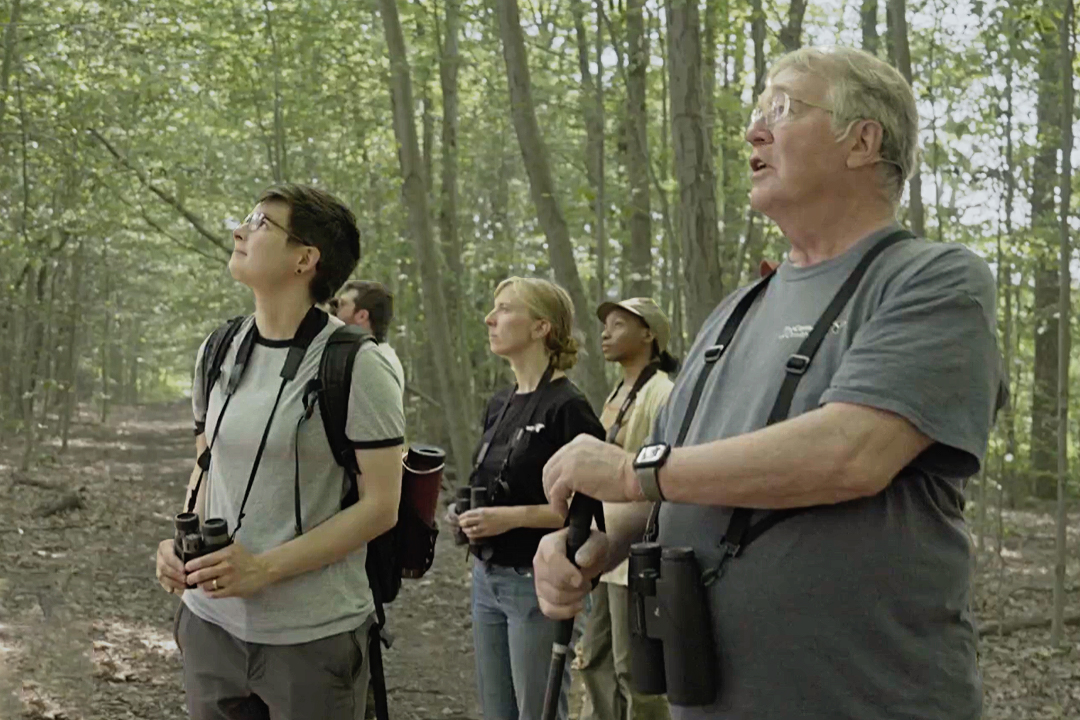
Every day around noon, Cornell Lab staff go for a walk in the woods with professional ornithologist and lead Bird Academy instructor, Kevin McGowan. We had a lot of fun premiering our short video, Walk in the Woods with Kevin McGowan, and celebrating the joy of spring birding. Then our co-hosts, Kevin McGowan and Samantha Hauser, jumped into your questions with a great Q&A session. Thanks for joining us!
Kevin is a prolific educator. He has written online courses on a range of topics including bird identification, behavior, and biology. He loves and enjoys all aspects of birds (especially crows)! And he wants to spread the appreciation of birds to all possible audiences, through all possible avenues.
Kevin came to Cornell in 1988 to be the curator of the bird and mammal collections in the Cornell University Museum of Vertebrates, and started a research project on the biology of the American Crow that continues to this day. Later, Kevin took over as the instructor for the long-running Home Study Course in Bird Biology. Bird Academy wouldn’t exist without him, and learning new things with him every day on our walks is a great joy!
Can’t get enough of bird ID and bird behavior? Learn more from instructor Kevin McGowan with these great online courses: