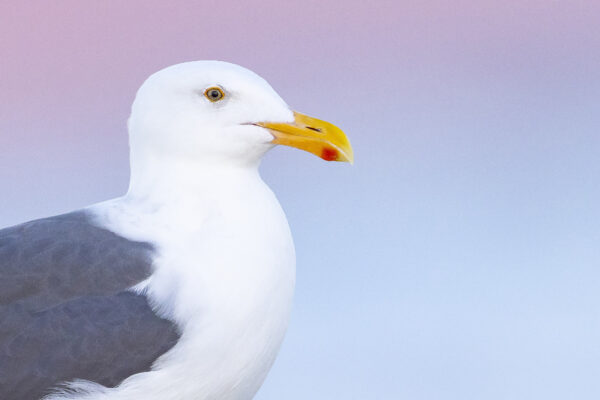
(Gulls Calling)
[Kevin] A dump can be a very active place with lots of frenetic motion of birds jostling for the prime places to get food.
The Cornell University compost piles are a great place to watch gull aggression and submission in action.
At the compost pile, birds have to dig through a covering of wood chips
and leaf litter to reach the waste food underneath.
Holes excavated in the side of the pile become prime assets to be fought over.
One way an [American] Herring Gull signals aggression is with a posture called the upright threat.
A bird extends its neck, bends its head down
and keeps its wings ready to whack an opponent.
(Gulls Calling)
Another threat display is the long call, a [American] Herring Gull sticks its bill
out and down, then swings it high over its head trumpeting a loud vocalization.
The long call is given as a threat or a challenge to another gull coming close,
or as a celebration of having beaten a rival.
But just making threats doesn’t keep a gull from being ousted by another, more aggressive gull,
or one that’s just bigger and badder. Even the most aggressive [American] Herring Gull
will usually just move out of the way if a larger Great Black-backed gull comes at it.
Some gulls try to hang around the edges of the holes and pick up stray bits of food.
These gulls often signal that they’re not looking for a fight by using submissive gestures.
A common one is the head-toss, a motion commonly used by chicks begging to be fed.
The gull pulls its head in and points its bill quickly upward, and then back down,
often making a high whistling sound.
A gull trying to avoid a fight will often give a head-toss
toward any other gull it thinks is potentially threatening.
Signaling submission helps,
but at the dump it’s no guarantee that somebody won’t attack you anyway.
(Gulls Calling)
Decoding Gull Behavior
Gulls are excellent communicators, and they can be a ton of fun to watch! Here are a few behaviors you might see while watching gulls.
If gulls intrigue you, you’ll want to know how to ID the ones you see. Tackle the challenge of gull identification with Bird Academy in our online course Be a Better Birder: Gull Identification.
Off