The Cornell Lab Bird Academy › Discussion Groups › Joy of Birdwatching › Activities: Noticing Behaviors
-
I looked at the Barred Owl cam. There are 3 (it took me a while to figure out how many) little owls. They are downy. At the start they seemed to all be just dozing. Then the back one started changing position as if snuggling up to one of the others, or maybe trying to wake them up. It opened its eyes and looked around an up, perhaps looking for the return of its mother. Then the second owl started pecking near the awake owls beak. At first I thought it was grooming the other owl, but then perhaps it thought maybe it had food for it. Finally the third owl which had been so curled up I thought it might be part of one of the other two stirred and I saw their were three. Finally the second owl started preening. Nice to watch them close up.
At the Ithaca feeder the mourning dove was standing on the edge of the platform with it's head almost totally in the bottom hole of the feeder although it seemed to take out only one seed at a time it took breaks between eating but ate right at the hole. A goldfinch then dropped in on a higher rung and it would peck in grab a seed pull back seeming to break the husk and drip it while eating the inside. Finally a grackle came by, the others flew off and it stood on the corner of the platform pulling seeds out. When it left a Blue Jay flew up and ate seeds from the platform picking them up and sort of tossing them back while lifting it's head, while another mourning dove pecked at the seeds eating with it's head down close to the seeds.
Out my window I can hear cardinals, blue jays, downy woodpeckers, song sparrows and maybe a mocking bird. There are other sounds I can't identify (but hope to with time). -
Activity 1: I watched a blue jay as he flitted back and forth between the seed feeder, peanut feeder, the ground and a nearby tree. He carried a whole peanut away in his beak and then proceeded to hold it against a branch pecking at it. I also noticed him swiping his beak against the tree branch.
Activity 2: The different feeding techniques I noticed were the downy and hairy woodpeckers pecking away at the peanut feeder, a house finch at a seed feeder picking at the seeds, a pair of rose breasted grosbeaks eating black oil sunflower seeds on the feeder and spitting out the hulls, and mourning doves and red wing black birds foraging together eating the seeds on the ground.
Activity 3: I heard at least 12 different species based on songs/calls. I find this to be the most difficult aspect of bird identification - associating the call with the bird out in the real world! The ones that I heard today that I can reliably identify are the blue jay, cardinal, red wing blackbird, American crow, mourning dove, gray catbird and pileated woodpecker (who was off in the distance). -
Activity 1: It was quite rainy today but, nevertheless, the birds were out exhibiting a range of the behaviors described in the lesson. As Kevin said: “To survive, a bird needs to eat and not get eaten.” These are a few of the behaviors I observed:
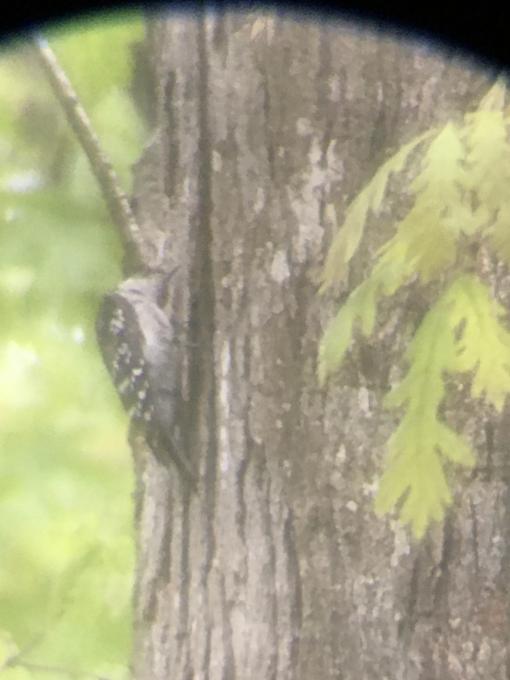
Foraging for food — catching insects: this Downy Woodpecker flew from tree trunk to tree trunk and, starting at the bottom and working her way up, proceeded to hunt for and eat (I’m assuming) insects.

Self care — beak cleaning: although I missed the quintessential act, you’ll have to take my word for it that a Northern Cardinal was cleaning his beak on a branch!
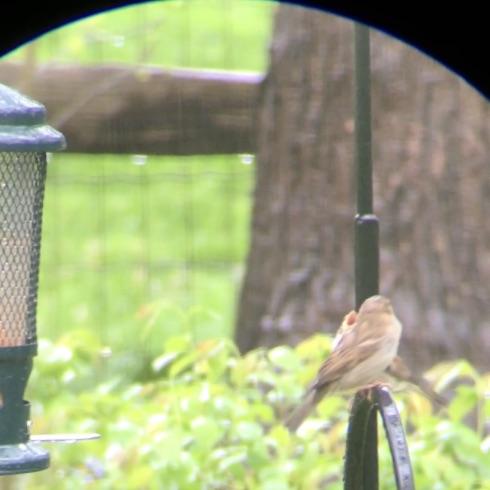
Parental behavior — feeding young: a House Sparrow went between the feeder and the feeder arm, bringing food to her cheeping fledgling (you can just make out the baby’s open and waiting mouth in this shot). I guess this pesky invasive has already successfully hatched a new brood…
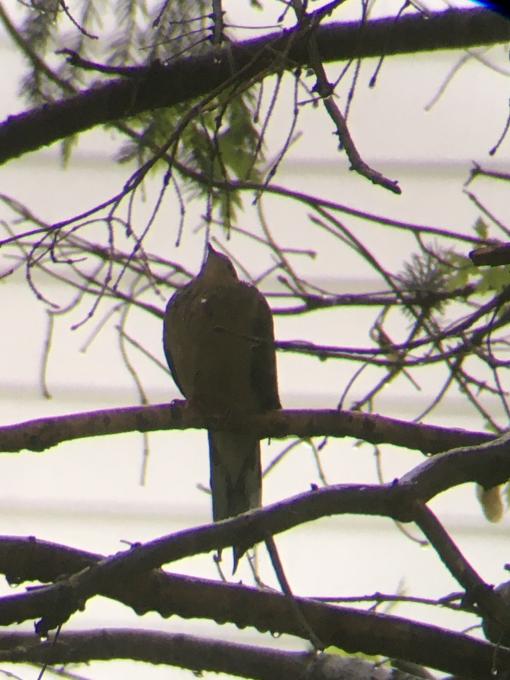
As I said, it was quite rainy, and I often wonder… what do birds do when it rains really hard? Perhaps this Mourning Dove has the answer: he (or she) sat very still in a tree with his/her head tilted upward, as if exposing a smaller profile to the sky(?).
-
At the bird feeder today the Blue Jay would take a seed and fly away and eat it them come back and get another seed and repeat. The Mourning Doves were foraging on the ground and the sparrows just hung on the metal change and ate until something startle them and then they all flew away.
-
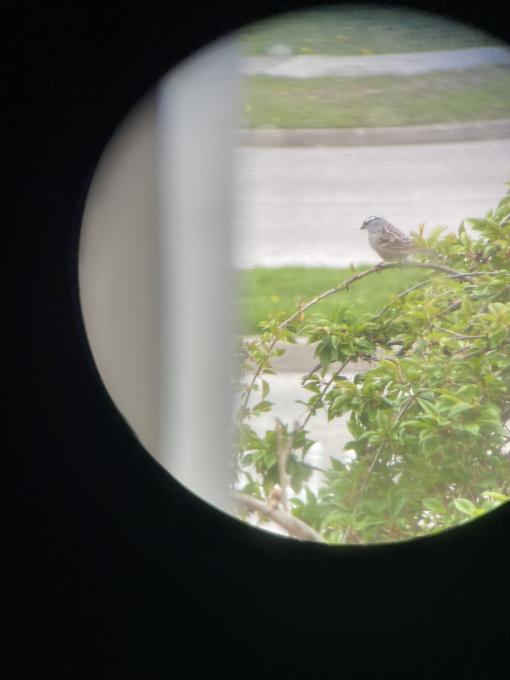
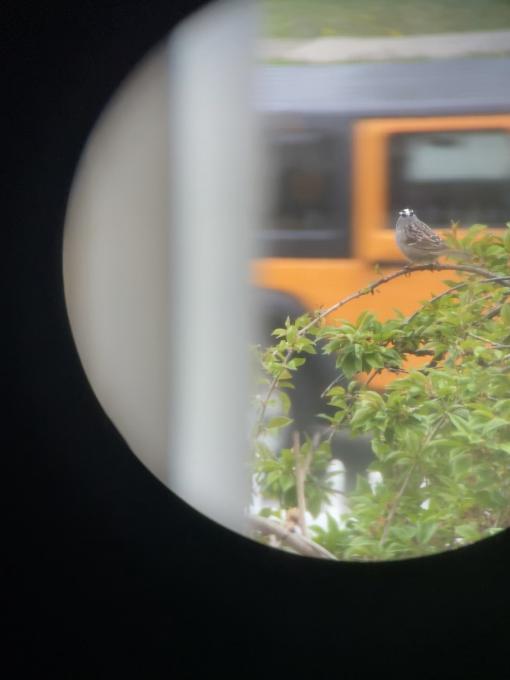
Activity #1 I glanced out the window today and saw a different looking bird sitting in a tree next to my feeders. I grabbed my binoculars to take a closer look. I'm so glad I did because it was a quite uncommon White-Crowned Sparrow. I watched him sit there brave as can be and then he began to pick at the tree a bit and move farther down it. Then he flew just a few feet and began foraging on the ground under my sunflower seed feeders. So excited to see an uncommon bird in a city setting.
Activity #2 I regularly have House Finches at my safflower feeder and they grab the seed and either feed right at the feeder or sit nearby and eat it and then go in for some more. Unlike the few chickadee and titmouse that show up where they grab a seed and then hide in the nearby tree and bang at the seed between their feet to get parts of it open. Then they will go back and get another seed. The Gold Finches at the thistle feeder sit there for a long time eating away but they have been getting more territorial with each other.
Activity #3 Around my house today, I heard House Sparrows, House Finches, Gold Finches, Tufted Titmouse, Cardinal -
Activity 3: Heard simultaneously this morning: crow, dove, wren, sparrow, hawk, warbler, hummingbird
Activity 2: Bewick's wren fiercely defending his territory when a Junco was at the feeder in the garden area adjacent to his nesting box on my patio.
Activity 3: Observed Bewick's wren couple for 30 minutes. Thought they were incubating eggs--just had paused in nest building. Today they picked up with nest building activity. Thought I'd heard pipping of chicks--just the male and female communicating in a different way than when they were singing. Female went into nesting box first and called to male. Male arrived later and sat atop nesting box. The two communicated in short, high pips, chirps, and cheeps. The male alternated between foraging and gathering nesting materials. Observed the male problem-solve: after consistently dropping willow branches that wouldn't fit through the nesting box hole sideways, he put them atop the nesting box and fitted them through the hole one-by-one. Later observed the male defend his territory from a larger Dark-eyed male Junco at a nearby feeder--shrieking and waggling his tail from side to side and hopping up and down until the Junco flew away.
-
Activity #1 I have pileated wood pecker who lives in the woods around my house and get to observe him almost daily. Today he spent some time on the ground close enough for me to have a good view. It looked like he was going through leaves, I assume to find bugs to eat. I love hearing him and watching him fly between the trees.
Activity #2 I have a bird feeder near the creek in my back yard. This week, I've seen three indigo buntings, which I think are just passing through. I've noticed they seem to stay on the ground and eat the dropped seeds more often than sitting on the feeder. We have two pairs of nesting cardinals and I've seen the males chase each other away from the feeder. I also have three suet feeders and have quickly realized that almost all the birds (with the exception maybe of the chickadees) prefer the peanut butter suet.
Activity #3 We have many woodpeckers in the woods around our house. I've heard the pileated call and recently have heard a red-bellied call and never realized how similar they sound. I'm not sure now if everything I thought was the pileated might have actually been the red-bellied!
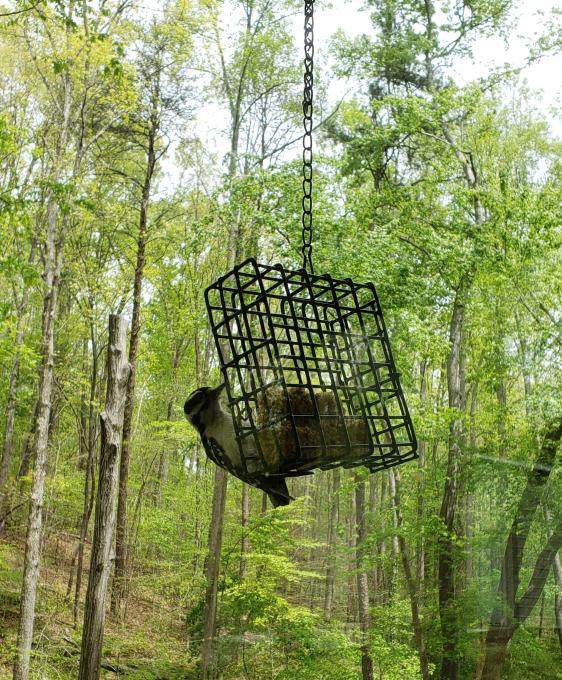
This is a downy woodpecker at one of the suet feeders (I think! I'm struggling to figure out which ones are downies and which ones are hairies. I think we have both!)-
This one's a Hairy Woodpecker so how long its bill is compared to its head it is almost the same length as its head. Whereas the Downy Woodpecker is only about half the size of the head. Hope this helps!
-
-
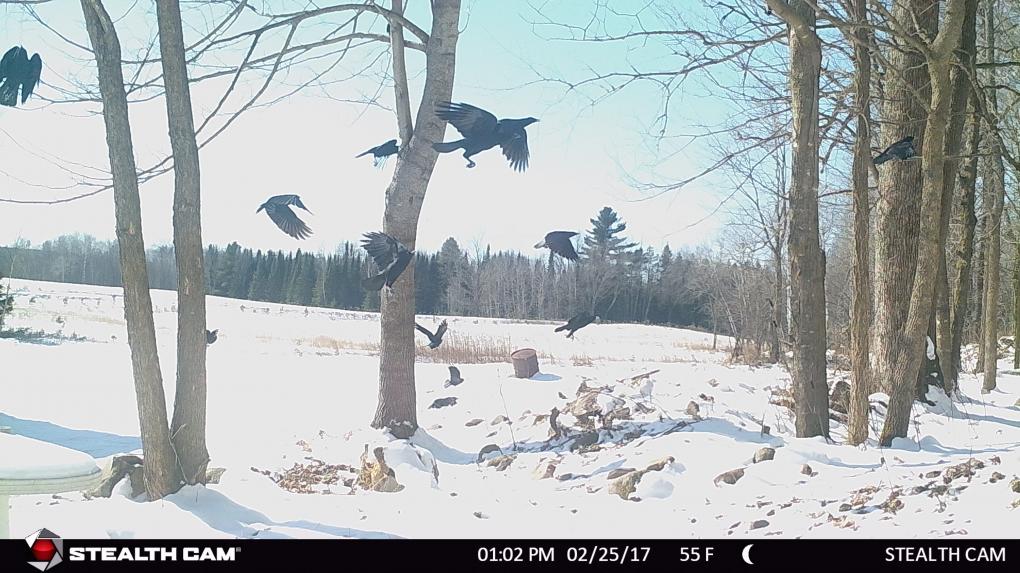
I also was able to get this image on another camera, a flock of Black Birds found something to eat. The more they called out, the more showed up. I wanted to share due to it shows so many different stages of their flight.
-
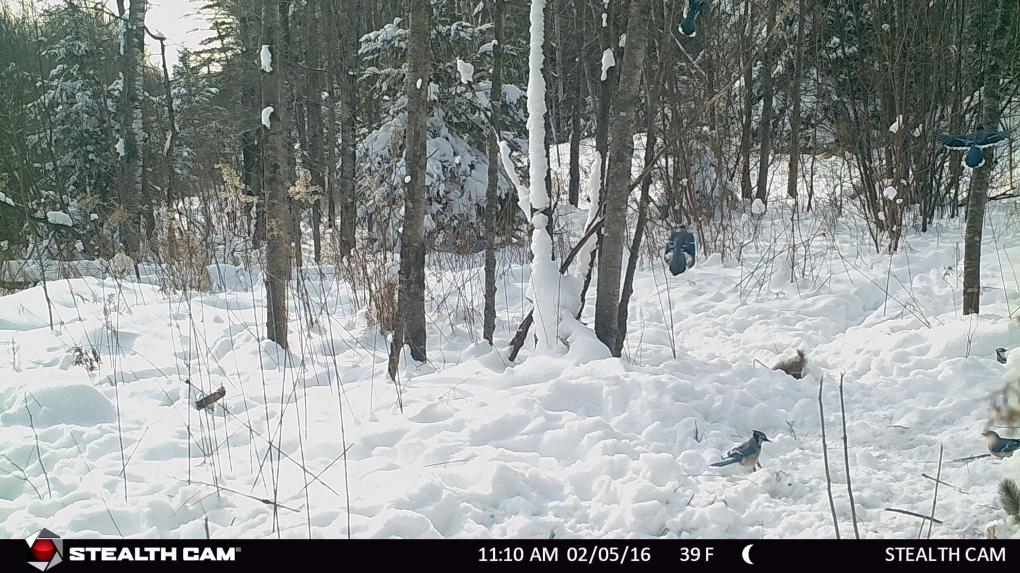
Activity #1: I watched daily, a flock of Blue Jays that hang out. I set up a trail cam near where they nest and over a winter got some really nice pictures on the cam. It almost seems like one sits high up in the trees while the others were foraging in the snow. (is that a feather from preening in the lower right?) Activity #2: I watched a variety at my home bird feeder this morning. A "flock" of 4+ yellow finches hanging out on a block i put in a hanger. Several brown headed cow birds at the feeder eating.Activity #3: Listening out my door this morning I could hear some Sand Cranes calling (the echo in the woods sounds like we live in Jurassic Park!), I heard the Red Wing Blackbird call and the distinct tap tap tap of a Woodpecker.
-
Activity #1: I watched a Hairy Woodpecker hanging upside down to jab at the Cornell Lab feeder that looks like the little rooftop of a house. He was really enjoying jabbing at whatever is in the feeder, and seemed perfectly content to be upside down hanging from the feeder by his feet.
Activity #2: There were a few Red-Crowned Woodpeckers (the caption said; I didn't know the name!), and one of them kept feeding fruit to another one standing nearby that was not feeding, just waiting to be fed. The odd thing was that they looked identical, so I don't think it was a male feeding a female, or an adult feeding a fledgling. Would one adult male feed another? I guess it's possible one had less red on the head, so was a female, but I'm not sure.
Activity #3: Listening outside my window for five minutes...it's a quiet day. I heard Northern Cardinal singing, and House Sparrows chattering. That's about it.-
I saw that too, and my conclusion was that it was a large fledgling still being fed. That's the only logical thing I could think of.
-
-
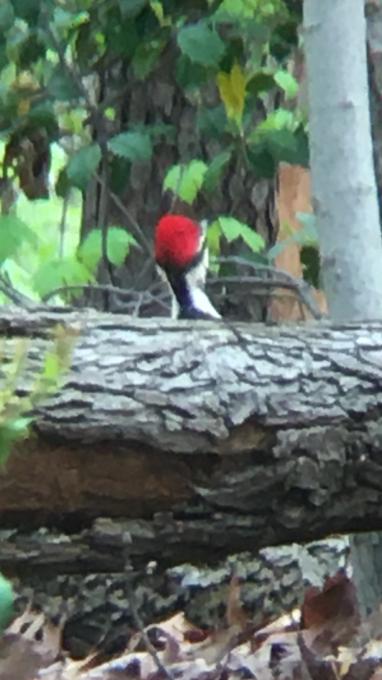
I’ve been listening to recordings of different birds, on Merlin and on a CD. When out walking today I heard a sound I recognized as a Pileated Woodpecker call, I looked and sure enough there he was. I almost got an even better picture of him on the side of a tree a few seconds later, but a person was walking from the other direction and the bird flew away.
-
Really neat picture!! This is my favorite bird. I have one in my trees, comes often to my bird feeder, but every time i try to get a photo he becomes camera shy! Thanks for sharing.
-
-
Activity 1: I watched the Red-Tailed Hawk cam for a little while, and got to see a hawk preening its feathers while sitting on some eggs! What a special view. The hawk used its beak to clean feathers on its belly and sides. We got a nice zoomed in view of two or three eggs in the nest. This hawk is not just preening, but incubating as well! After a while, the hawk stopped preening and went back to sitting still and looking around.
Activity 2: I watched the Cornell Feeder Cam for a bit, and noticed a few different feeding behaviors. A European Starling picks up seeds and cracks them in its beak, eating the insides. A Mourning Dove picks up seeds it can easily eat, and does not break them. Unlike what I read in the lesson, the Blue Jay I saw eating at this feeder selected seeds it could quickly swallow whole. A strange, fluffy bird with four legs and a big tail arrived to eat a snack. It scared all the other birds away. I could not identify this bird in the Merlin app, leading me to think it was a VERY rare sighting! ;)
Activity 3: I listened to birds on the feeder cam. I recognized a blackbird, a chickadee, and a goose. Because this is an east coast camera, there were many other sounds I did not recognize.-
Keep those four-legged fluff balls safely ensconced in "cat patios" to protect our bird friends -- especially during nesting season! https://www.allaboutbirds.org/news/faq-outdoor-cats-and-their-effects-on-birds/
-
Read More: