The Cornell Lab Bird Academy › Discussion Groups › The Wonderful World of Woodpeckers › The Life of Woodpeckers
-
Bird AcademyBird AcademyDrumming is one of the signature woodpecker behaviors. Now that you’ve explored how drumming functions like song does in other birds, share your drumming thoughts and stories.You must be enrolled in the course to reply to this topic.
-
I never really paid attention to the drumming sounds until I was on a hike in Colorado and heard the Williamson's Sapsucker drumming. It was fast and then slow, slow, slow, slow. Caught my attention and I was able to see several of them on the hike.
-
It's cool to know that drumming sounds different depending on the type of woodpecker. I also didn't realize that they answer other woodpeckers in the same way as other birds that use their song for that. I've seen 4 different types of woodpeckers in my neighborhood. I saw a pair of Pileated woodpeckers who were moving around in a smaller maple tree and even were on the ground around it. I can now tell when the Pileated woodpeckers are drumming versus the Downy woodpecker, who do a faster drumming.
-
I've only had the change to hear once a Woodpecker drumming and it was definitely looking for food, since it was also moving quickly around the tree.
-
The drumming I have heard occurred while living in Virginia. I would often hear the Pileated Woodpeckers , there was a male and also a female who lived close by . The area had a lot of trees and deer. After listening to the recordings it sounded like territorial drumming.
I really am enjoying this course! It's informative, fun, and I like these discussion sections. Fantastic Course! Thank you, Cornell Lab of Ornithology and thank you Kevin McGowen! -
I love to listen to the woodpecker drumming on the nearby trees especially when their mate answers them. To me it is a sign of spring and a happy and busy time for the birds. Can't wait for spring.
-
Last summer I was hiking up the last half mile along a trail that climbs up a hillside in a mixed aspen and conifer forest when I heard the drumming of a Red-naped Sapsucker. This location is along the Cub Lake trail in Rocky Mountain National Park just before the trail reaches the open meadow with Cub Lake. This is a traditionally great location to see this woodpecker during nesting season. To my surprise last summer on this particular hike, I heard a different drumming pattern
 . I followed the trail and came to an aspen tree that a Northern Three-toed Woodpecker was drilling on. I was unable to get back to see if the Northern Three-toed had a successful nesting season. I did get a photo but the quality was not too good so I am not posting that here. Instead I am posting the Red-naped Sapsucker I was lucky enough to catch in good light.
 -
While this photo is not related to the question, it does show a young Northern Flicker calling for it's mother. I wonder whether anyone reading this post has ever seen a young woodpecker drumming to get it's parents' attention? In this case, the tree is a weeping willow, so I imagine the wood would be too soft to produce a loud sound.
-
I do not know if I have noticed the babies drilling from inside the hole, ours nest in Ponderosa Pines around my home. But they sure do vocalize loudly the last week or so! I enjoyed your photo!
-
-
I know from friends and neighbours that drumming on surfaces other than trees is pretty common. One of the things I've wondered about is drumming on metal. This must put much greater stresses on the bill than drumming on wood. Does it not cause damage to the bill?
-
-
This text was meant to accompany the photo I posted above:
I first heard, then saw this West Indian Woodpecker at Playa Jibacoa, Cuba in February 2008, on a winter vacation from Canada. They were drumming on the window frame. Thanks to this course, I am now aware of this form of communication amongst woodpeckers. Second photo follows of what I think is the same woodpecker. -
@Michelle
-
@Michelle These are fantastic images! Thank you for the info too. I really enjoyed reading about this woodpecker!
-
-
I'm lucky to live in a rural area and my yard, I call it 'the wildwood ', is home territory to hairy, downy, pileated(a male/female pair) and a red bellied woodpecker and flickers. I really enjoy hearing the drumming, especially that loudest of the pileated woodpeckers. Gosh, I'm shocked to read in this course that woodpeckers don't have downy feathers!!! It's in the single digits here tonight....how ever are they keeping warm??????
-
We are always excited to hear the loud drumming of Pileated woodpeckers in the forest near our cabin in Central Idaho. They definitely let you know when they are visiting!
-
It's super helpful to know that sapsuckers drum more erratically than other woodpecker species. I feel like that will make Yellow-bellied sapsuckers easier for me to find and identify in the spring this year. Would really love to hear some of the "double taps" from woodpeckers who use that method in other parts of the world--we don't have any around here. Someday!
-
Flickers are frequent visitors in backyard. Spring great time to hear different calls can't wait to start listening to try and know what is being communicated.
-
I love to watch and listen as downy and hairy woodpecker parents teach their young to access our peanut feeder. Very noisy young!
-
Drumming and the general woodpecker vocalization are, in my opinion, rarely discussed in the field of avian communication. Generally, the topic is based on parrots and passerines, but not the majority of other avian groups. Given that we have so much research on that, as well as evolutionarily speaking, woodpeckers are closer to parrots and passerines, I wonder if woodpeckers too have a sense of grammar and syntax? Can some of the examples in this course be considered as such? It would make a great research topic. I would not be surprised if they are.
-
My husband and I LOVE the pileated woodpecker drumming! Whenever we are out hiking we recognize it right away! We have been waiting patiently to hear one at our house!
-
I hear Acorn woodpecker drumming all the time, where I live. Before this course, I thought they were drilling holes. Now I understand, they are just communicating. I can actually hear the drumming from quite a distance. They are also quite chatty! And when it comes to creating a ruckus - they are stiff competition to Stellar Jays, another interesting bird I see here.
-
Drumming to suggest fitness seems like a pretty smart adaptation. Would be really interesting to know how the behavior began and how it evolved to be relatively uniform within species.
-
Interesting behavior but I am not sure I can hear difference in drum type.
-
The first time I heard a Northern Flicker, I thought it was a bird of prey!! I got hard time identifying him. I worked on a golf course and I was always hearing it but never seing it! Then I finally found! Amazing! Most of the other woodpecker here in Quebec are easy to recognize by their call sound! I just love to hear their drum at the farm
-
I live in a mixed woods, with mature hemlock trees covering a third of our land. My husband and I love to hear the spring drumming of the our local woodpeckers... pileated, downy, hairy, red-bellied and sap suckers. The sap suckers, make us nervous, knowing that we might find their sap holes later, on various tree trunks, like we did last year, on our beloved Tulip Poplar. In early spring, we know the sap sucker has arrived back, when we hear him drumming on a metal post nearby - a love calling but - a warning for us!
-
drumming shows communication about location and maturity status according to territory needs and conflict for resources.
-
Seeing the clip of the yellow bellied sapsucker drumming on the sign, reminded me of the first time I had witnessed one drumming on a dead-end road sign. I was walking my dog and didn't have my binoculars that day. We approached slowly, so that I could get close enough to identify the bird. I was surprised to spot the yellow-bellied sapsucker on the sign. I hadn't realized that they would drum on signs, and I had not realized we had any nesting in the area.
-
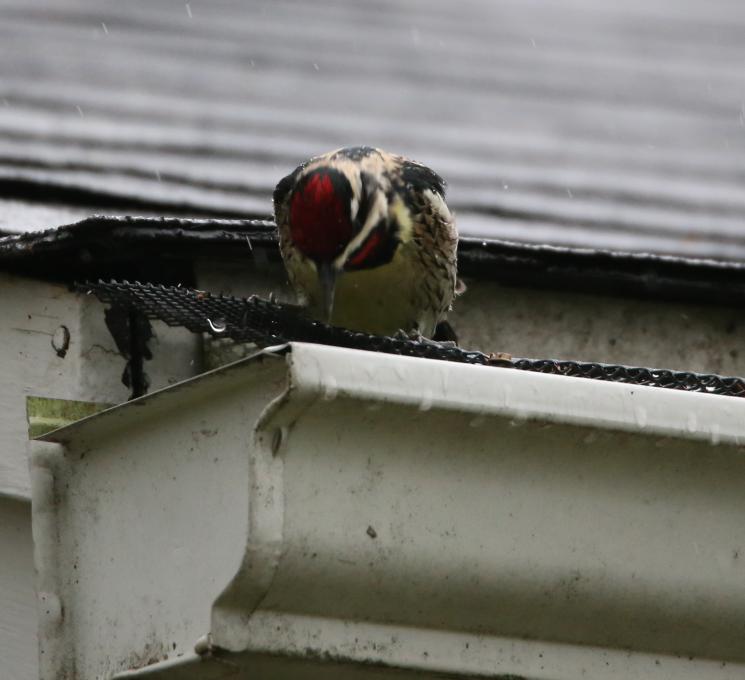
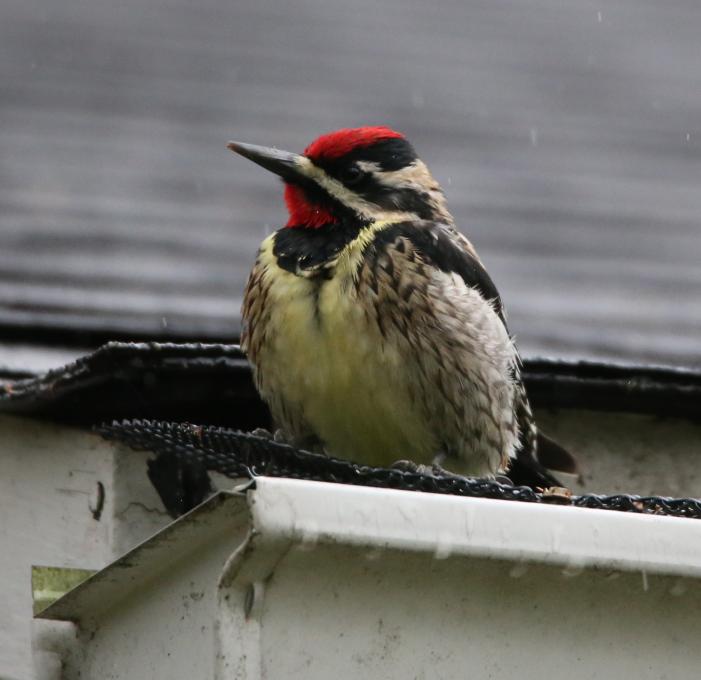
When the Yellow-bellied Aluminumgutterpecker arrives in my neighborhood, it sounds like someone is firing a machine gun.
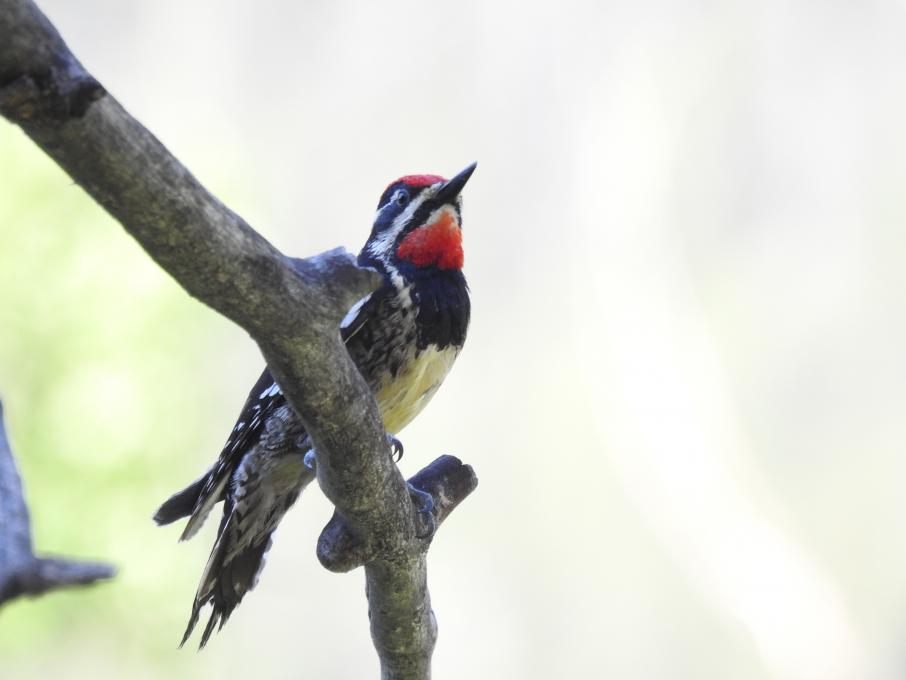 . I followed the trail and came to an aspen tree that a Northern Three-toed Woodpecker was drilling on. I was unable to get back to see if the Northern Three-toed had a successful nesting season. I did get a photo but the quality was not too good so I am not posting that here. Instead I am posting the Red-naped Sapsucker I was lucky enough to catch in good light.
 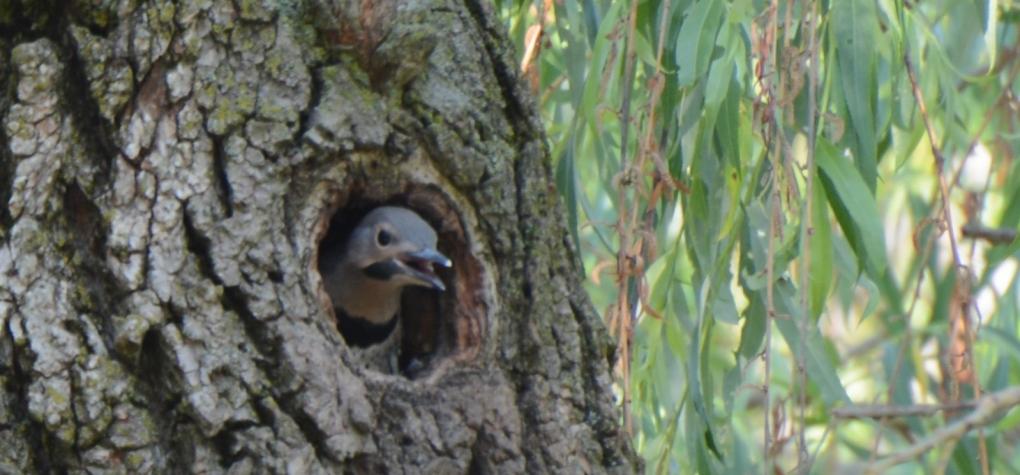 While this photo is not related to the question, it does show a young Northern Flicker calling for it's mother. I wonder whether anyone reading this post has ever seen a young woodpecker drumming to get it's parents' attention? In this case, the tree is a weeping willow, so I imagine the wood would be too soft to produce a loud sound.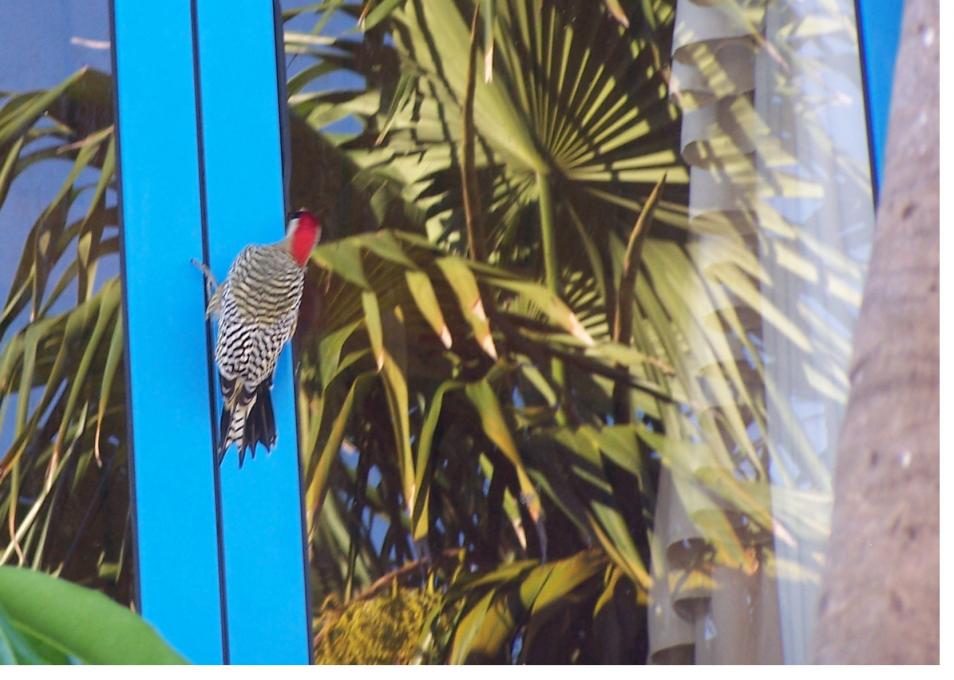

Read More: