The Cornell Lab Bird Academy › Discussion Groups › Joy of Birdwatching › Activities: Different Seasons, Different Birds
-
In these activities I note that in the first birds compared the ranges are often very different. Either mostly east vs mostly west, or that one species migrates very little but the other has quite a wide range.
In the second activity there are apparently a lot of birds that are in my area of the NE all year round. More than I thought. On the other hand, there are also many seasonal birds some of which I have never seen nor even heard of so perhaps that's because I wasn't attentive to them 'seasonally'. These would include the Ruby Crowned Kinglet, the Northern Parula and the Yellow Rumped Warbler among others
In the 3rd activity I see that the gold finches really change quite a bit from summer to winter. The first thing that struck me was that their bellies seem might lighter/whiter in color so the blend in better in the winter and they seem to loose the black cap on their heads. Their beaks also change color becoming less bright. It's amazing to me that their beaks can change color (but also seems to me to make identification that much more challenging).
The loons also change color a lot. Their colors are intense black/white and blue or blue green in the summer but more gray and brown in the winter. They loose that distinctive black head in the winter as well as that blue collar and the prominent black and white patterning on their backs.
I don't have a favorite spot yet, but there is a park near me that runs along an estuary and has marshes as well as trees and lawn so that might be a good place to look. There are areas of woods and forest near me as well as marshes so I think I'll have to look up what should appear in each and then try and explore (when things open up again - right now all parks are closed by me). -
Activity 2: This was a fun activity (modified slightly to focus on three instead of six birds)! The animated range maps add interesting dimensions to my bird watching: “when” and “where.” So, now, in addition to thinking about what I saw, I can also consider what I might -- or might not -- see next.
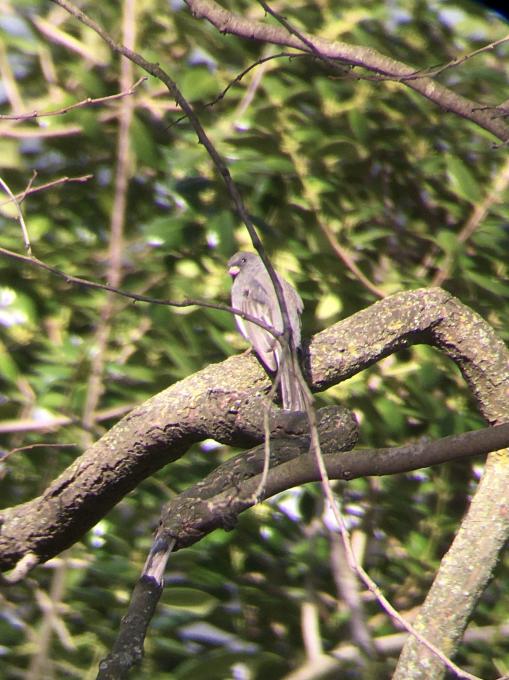
Dark-eyed Junco in late March. This was one of the last times this year that I saw this inquisitive little fellow. According to the abundance animation (https://ebird.org/science/status-and-trends/daejun/abundance-map-weekly), they’ve largely migrated to the Northern United States and Canada by this time of year but should be returning in the fall.

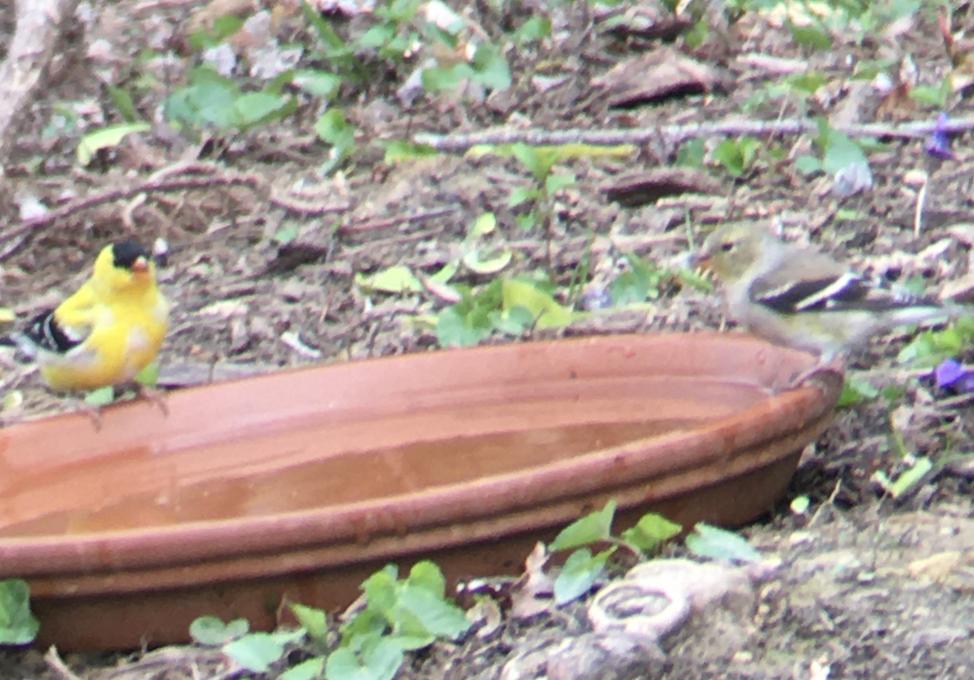
American Goldfinch in early April. While not a good photo, this was the first time since last year that I’d seen these birds. According to the animation (https://ebird.org/science/status-and-trends/amegfi/abundance-map-weekly), however, they could be present in my area throughout the year. Perhaps nonbreeding plumage or an overall lower density in winter help explain their apparent absence.
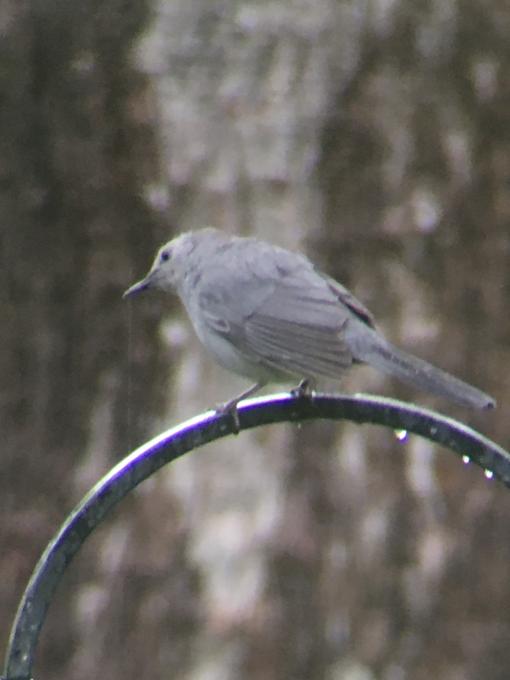
Gray Catbird in late April. I remember seeing these dapper fellows last year and am pleased to have noted one’s arrival the other (rainy) day. According to the animation (https://ebird.org/science/status-and-trends/grycat/abundance-map-weekly), these birds spend the non-breeding season along the Gulf Coast, the Caribbean, and in parts of Central America before moving into the midwest and northeastern parts of the United States.
Travel safe, bird friends! -
I have recently seen an American Goldfinch here with still winter plummage and was surprised at how bright yellow he will become. The other surprise I had...I did not know that loons look so different in winter. If I have seen them I don't think I would recognize them. Thanks!
-
Activity #1: I was interested to learn that the Northern Cardinal is a year-found bird in NE U.S. (the abundance didn't really change throughout the year); whereas the Blackburnian Warbler only summers in the NE U.S., while wintering in Northern South America. The tanagers were very different: the Scarlet Tanager is a migrant, living in the NE U.S. May-Sept, and wintering way down in northern and northwestern South America. The Western Tanager lives in western U.S. about May-Sept., and winters in Mexico and Central America (it doesn't go as far as the Scarlet Tanager). The ruby-throated hummer lives in the Eastern U.S. and southern Canada about May-Sept., and winters in southern Mexico and Central America...whereas the rufous hummer lives in western U.S. (NW mostly) May-Sept., and winters in southern Mexico. As for the sandhill cranes, they summer in northern Canada and Alaska (which surprised me), and winter in FL and TX; whereas the smaller yellow-bellied flycatchers summer way up in western Canada and NE U.S., and winter in Central America.
Activity#2: I've seen the following three birds year round in NY: Northern Cardinal, Chickadee, and Rock Pigeon....although I didn't see many Chickadees this winter (someone said they were cyclical, so I hope we see more next winter.) Three birds I see onl part of the year are Scarlet Tanager (which winter in Central America); Wood Thrush, and Yellow Warbler, which winters in northern and Central America.
Activity #3: In summer, NY Goldfinches have their black caps, and bright yellow breast and back. In winter, the black cap disappears, and their yellow is very pale. But, I noticed that the black wings with white wing bars stay year-round. As for the Common Loons: in summer, they have a dark black head, striped necklace, and checkered back; whereas in winter the black in the head and the checkered back are muted, and there's no necklace. The neck and breast are white.
Activity#4: Now (April) in NYC's Inwood Hill Park, I'm seeing Northern Cardinals, Robins, Rock Pigeons, Starlings, Mockingbirds, Flickers, House Sparrows...the spring migration (which I think peaks in May) hasn't really started yet. In six months, I'll probably see most of these same birds, many of which don't migrate. If I see migrating warblers in May, they won't be here in six months. -
Being a beginning birder I don’t know species names so it is difficult to use ebirder quickly.Or maybe there is a trick to accessing common names to do a search.Thanks for any advice. Carol
-
Using eBird would be a loss for me without also using my Merlin BirdID app! I am new to bird watching, so before I go out I use Merlin to predict what birds I might see. It helped me today when I saw Harris's Sparrow. I knew it was a sparrow, but it had an "oil spill" on its face and neck that the House Sparrow doesn't have. Because I studied the birds in advance, it really helped me out! Then I was able to match that bird with the birdsong I had been hearing.
-
Hi Carol: I like Merlin too, and the explore birds option. I also have a trusty field guide which I bought years ago. It has lots of color pictures and it organizes birds by general category. My book is rather old. I remember wondering if I should buy it and am so glad I did! There are many paper guides, I imagine, but mine is called "A Guide to Field Identification: Birds of North America" by Golden Press publishers.
The Cornell Lab also has alot of information about birds on it's website.
I've always enjoyed watching birds but am really learning alot in this class.
Good luck.
-
Read More: