The Cornell Lab Bird Academy › Discussion Groups › The Wonderful World of Woodpeckers › How Woodpeckers Rule the World of Wood
-
The tongue provides no cushion for the impact of pecking? Not even a little?
-
In the lesson “Why and How Woodpeckers Peck,” I question the statement: “If there was shock absorption, it would soften the woodpecker blows, making them less effective.” I’m not sure that is accurate, and I offer the analogy of the shock absorbers on a car. Although the shock absorbers cushion the occupants of the vehicle, the tires still hit the object with the same amount of force; the impact is not softened.
-
I agree. It doesn't make sense to me either. I have several books on birds and all say that it the thickness of the skull and the other features help protect the woodpecker's brain. A BBC article had this information which makes more sense to me.
"The birds have little "sub-dural space" between their brains and their skulls, so the brain does not have room to bump around as it does in humans. Also, their brains are longer top-to-bottom than front-to-back, meaning the force against the skull is spread over a larger brain area."
-
-
The structures on the ends of their tongues are fascinating, varied just like the colors between species. I also think the tendon extending from the nostril on those with longer tongues must be incredibly strong. So cool because it's so tiny.
-
The way the tongue wraps around the head is so interesting!
-
I love that woodpeckers excavate nest cavities, acting as ecosystem engineers and providing nesting spots year after year for other cavity-nesting birds. I also love listening to them drum to establish territories or attract a mate. Morphologically, I think their strong, stiff middle tail feathers that act as a tail prop are quite a cool adaptation.
-
My favorite adaptations that help with woodworking are their zygodactyl toes and stiff tail feathers that allow them to stand on and move up tree trunks. I really enjoy watching our local species around the Sacramento valley make their way up and around the trees. My favorite adaptation of woodpeckers overall though is their coloration. I love the black and white patterns and bold splotches of color on many species.
-
My favorite and surprising adaptation is the way the long tongue fits inside the small head of these birds.
-
The sound produced. The rhythm of the beats typical of each species to mark territory and how individuals of very small species produce such loud sounds!
-
There was red belly wood pecker around our house for years that pecked on a metal yard light and the sound carried an impressive distance
-
-
The woodpecker's tongue is very interesting. The various ends of their tongues, adapted to help them find their specific kind of food, was interesting the learn and see through pictures.
-
The tongues are amazing!!
-
the call of the red bellied woodpecker when I step outside to fill the bird feeders. two chickadees and this woodpecker are waiting. then I hear his drumming on the dead trees. knowing he stays around.
-
I have always been fascinated by their tongues. The length and the different barbs etc. that are on the tongue.
-
The whole woodpecker is impressive!
My favorite adaptation is the amazing tongue. -
I am quite intrigued by the adaptations for balancing on a tree trunk, including stiff tail feathers and the zygodactyl toes that move out to the side.
-
Hi, Cornell Folks! Here is an adaptation of a different sort:
A few years ago we had 1 or more Hairy or Downy Woodpeckers that liked to stand on the lateral piece of metal pipe that connects the Gutter to the Downspout & drum away. Quite loud nearby.
Regards
Rich-
Hi there, Rich. For several years we had a male red-bellied woodpecker who would drum for extended periods on the gutter running just above one of our bedroom windows - a incredibly loud and reliable (if not always so welcome) wake-up call for us and a very successful mating call for him!
-
-
The tongue adaptation is quite unique. Not only the extreme length (I thought hummingbirds had the longest tongues) but also the various tips. I'm going to have to pay more attention when I see one foraging and see if I can glimpse the tongue in action.
-
I find the tongue adaptations to be most interesting.
-

-
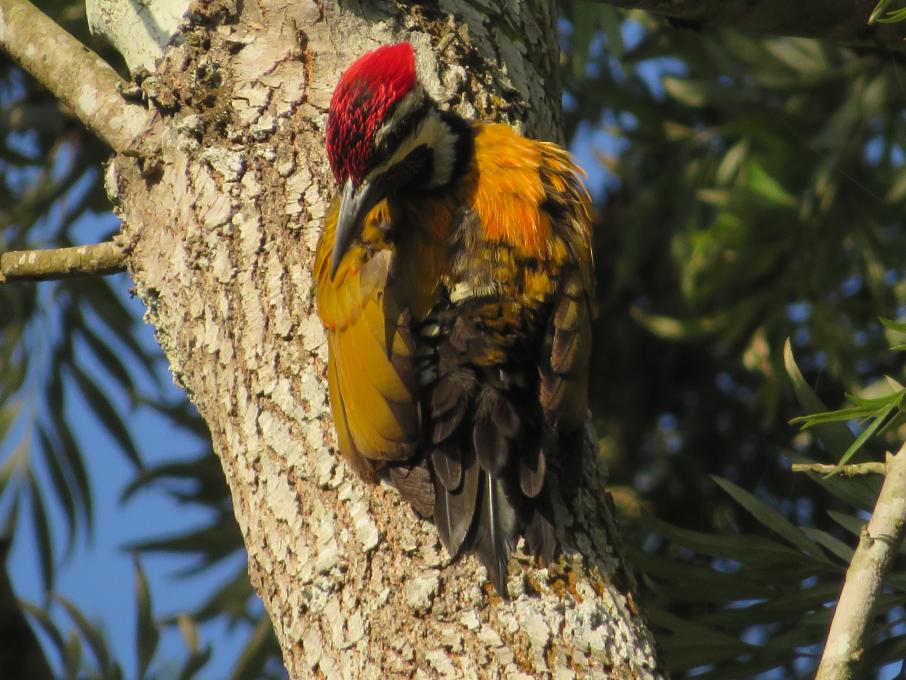
What a stunning photo! Thank you for sharing this!
-
@Nikita THANK-YOU!!
-
wow!!!!
-
-
I don't run across woodpeckers very often in Northern California (easier heard than seen), so I was happy to find the Black-cheeked in Panama and Costa Rica and the Acorn also in Costa Rica while photogaphing birds. I understand that one or both are also found in the U.S. I was surprised to learn abot the length of their tongues and how the tips differ.
-
I'm also in Northern California and here in the Bay Area we have several species. I have a suet feeder hanging from the eaves in front of my dining room window and see Nuttall's and downy every day.
-
-
I found the tongue adaptations to each specific food source fascinating. I never considered that before. I also found the drumming on wood for communication interesting. I will definitely be more mindful of woodpecker behavior when watching them.
-
Question: My son told me this tidbit referencing the tongue protecting the brain whilst the woodpecker pecks; we found this source on the internet. Is this true or not? I’ll admit I’m skeptical!
“This unique arrangement creates a protective cushion that absorbs shocks and minimizes the impact on the brain each time the woodpecker drills into a tree. It’s like a natural shock absorber, so the brain doesn’t get damaged from all that rapid, forceful pecking” -
The adaptations of the tongue are incredible and new to me. I also find it amazing that their beaks are so hard. Humans use metal tools to work wood, but they use their beaks!
It caught my attention that the communication method is mentioned as drumming, but where I am, woodpeckers also vocalize. For example, the Lineated Woodpecker (Dryocopus lineatus) makes at least two sounds: an alarm call like "ui-ui-ui-ui..." and another that seems to indicate presence, like "Pi-prruuuuu."
I'm also curious about how they can feed on ants without being bothered by their attacks. -
I appreciate that the woodpecker have different intents when they are pecking at wood. I especially like the drumming to announce territory and to look for a mate. I will listening more this spring in hopes of identifying the mating drumming.
-
The tongue adaptations are fascinating!
-
I knew that woodpeckers have long extensible tongue but I didn't know that the tip has evolved differently for each species.
Read More: