The Cornell Lab Bird Academy › Discussion Groups › Nature Journaling and Field Sketching › Jump Right in!
-
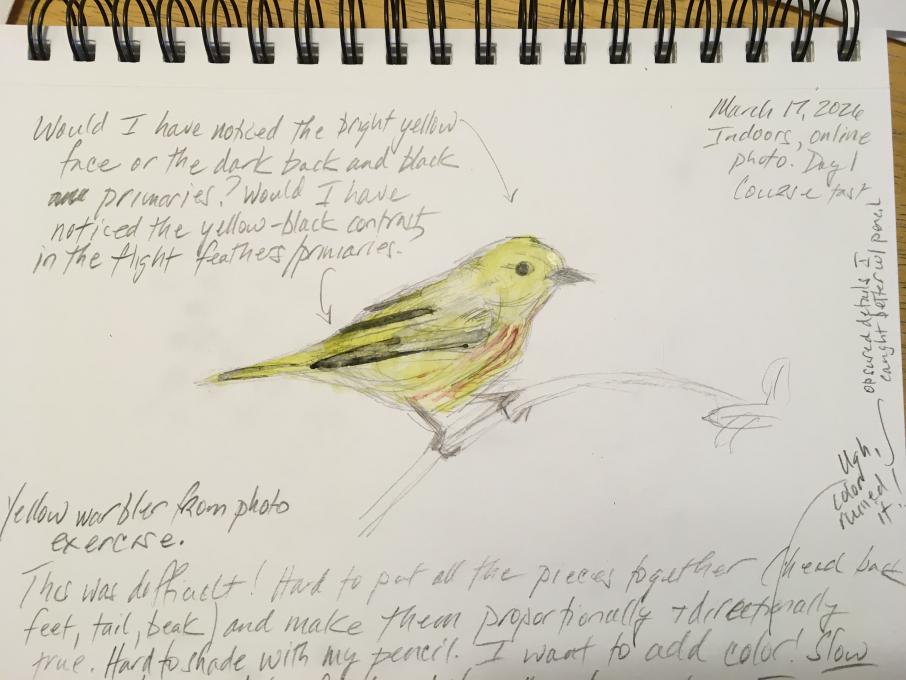
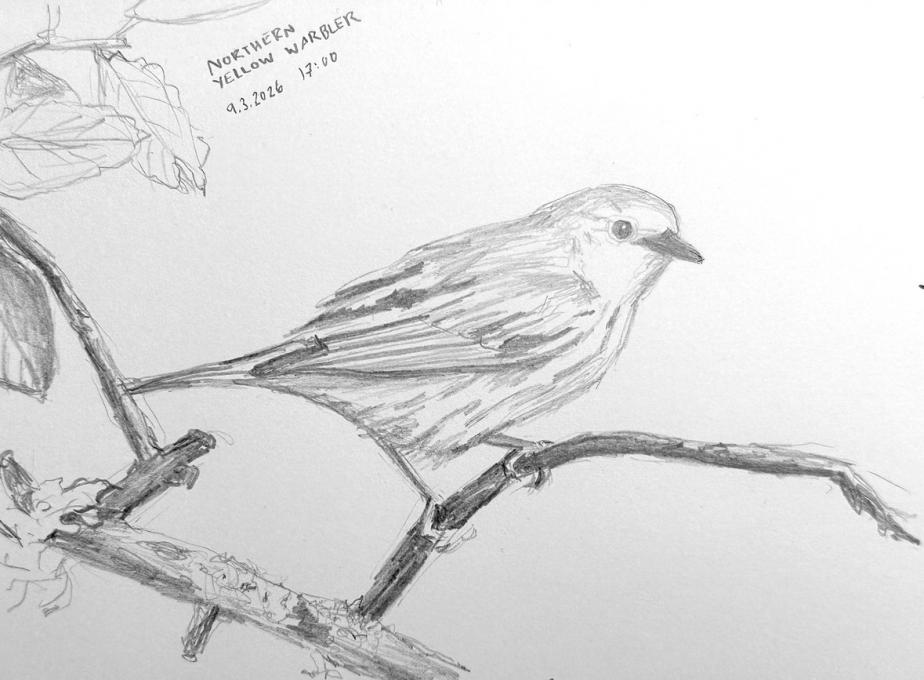
Bird AcademyBird Academy1. How did you feel about drawing from the photo? What came easily and what was challenging?
2. Was there anything in the photo that you might not have noticed if you weren’t asked to draw it? Would this make a difference when nature journaling?You must be enrolled in the course to reply to this topic. -
1) I felt I not that good at drawing, but it felt good to actually having to observe and see the picture rather then take the photo and not pay attention until you see it later. I felt like it was more in the moment and taking the time to appreciate the bird. What came easily was drawing the outline of the bird, but when it came to the details of the black and yellow height light and also transferring three dimensions onto a two dimensions drawing was also challenging.
2) I think I took more notice on the shape and posture plus the yellow and black highlights in the feathers. I feel it would be because I think journaling you take you time and actually notice the birds, giving you more time to appreciate instead of taking a quick photo and moving on. -

I have been drawing for many years so I feel very confident drawing from a picture. This one I drew while on an airplane so I didn’t have my watercolors on hand. I will add color later.
I realized how much detail I started noticing as the drawing progressed. More of the texture of the feathers and the shades and colors. -
2. Was there anything in the photo that you might not have noticed if you weren’t asked to draw it? Would this make a difference when nature journaling? Yes, I would not have noticed the different lichens on the branch, the detail of the leaves and how the bird's foot grasped the twig. Being aware of this additional detail certainly makes for a more enriching journaling experience.
-
1. How did I feel about drawing from the photo? Awkward. It felt backward to me. Easier for me to draw when the bird is facing left. How odd is that? I was working with watercolor pencils so I had problems blending. But I'm completely new to watercolors, on top of being new to drawing, so why not dive right into the deep end of the pool. Coloration was difficult for me. Shape was also difficult. Heck, everything was difficult.
2.What might I not have noticed had I not drawn it? Perhaps the shape of the tail. -
-
I liked having time to draw the photo as a still shot, as opposed to a bird moving around in nature. I struggled with the angle of the bird and it's beak the most.Had I not been asked to draw the photo, I may have missed the reddish hue of the stripes on the warbler's chest. I enjoyed trying to caputure the scalloped effect of the wings. -
Working from a photo provided time to study shapes and colors, but challenging to get the perspective and angles just right. Hard for me to make the bird seem “alive”, rather than flat with minimal detail. Noticed more of the interesting details of the branch than I would if I hadn’t drawn it.
-
Beautiful!
-
-
For the first time drawing I felt fairly good about it. There is much for me to learn. I didn't use the watercolors with time as I am not sure for to use it. Hopefully they will be a lesson on using water colors soon.
I feel that sketching/drawing made forced me to focus on the detail of the bird I was drawing. Photography can be very effective but the photographer focuses in on what she see is important. -
1. the proportions were easier to dray than I would have thought
2. details, mostly the feathers or the tree bark were harder to draw -
1. the body was hard to get down properly, the sculpting of it was easy but the feathers were confusing.
2. the branches felt important to include as it was what the bird was standing on. other than that it could help identify what types of trees the bird likes. -
Drawing from the photo was fair. It was easier to draw the bird as in nature they are quick to move around.
The did provide details of the bird and the branch like lichen. Yes, this does make a difference in nature drawing. These details can say a lot about the environment.
-
- I was very self aware of the drawing process, trying to give my best effort.
- I think that experience is very different in the field vs in front of a computer
- I want try and focus on the shape, size and value and allow myself room to grow but become an observer
- I am really interested in what my process will be and see how it evolves over time
- I excited to see my growth!!
-
1/ Initially quite positive but started to feel less comfortable once underway.
Easy:
a) The overall shape and proportions of the image
Challenging:
b) The ability to find/mix the colour match.
c) The ability to paint feather textures in areas of solid colour
d) The ability to paint fine straight lines
e) The ability to convey movement or life
2/ The detail in the birds feet. One foot was gripping the branch the other was just a rest.
-
1. I feel that I'm able to form a more intimate connection with subjects (in this case, the warbler) when drawing them compared to photographing them. I find myself asking more questions about the subject and learning more as a result. I focus more on the colors, shapes, and small details that make a subject unique when, with my camera, I can point, snap, and move on. From my drawing, the most exciting part came when it was time to color! Watercolor is a medium I began using within the last year, and I have fallen in love with it. Sketching and water coloring both come easily to me, though I do struggle with scale and over-corrections when I make mistakes.
2. If I was to photograph the bird rather than sketching it, I may not have acknowledged the intricate weaving of black and yellow feathers on the bird's wings. This would certainly make a difference when nature journaling, as not having small details like this would create hardship when trying to identify the species later after returning from the field. -
1. I felt better than I thought I would about drawing the photo, and I tried to do it pretty quickly and not worry about mistakes. I tried just focusing on the overall shape and proportions and it helped me. I tend to start beak first for some reason though.
2. I don’t think I would have noted the color of the legs if I had not drawn it. Leg coloring can really help with id for some shorebirds. -
I would never have realized how many different kinds of feathers this one bird has, without taking the time to draw it. I also noticed more about the feet by studying how they wrapped around the branch. -
1. Intimidated. A rough sketch came easier than I thought, but constantly judging the accuracy was tough
2. This little bird has quite the blocky head. -
-
I have always done better drawing from a photo than from a natural setting. I am able to transfer what I see in the two dimensions of a photo. I am challenged by the actual three-dimensional perspective. Shape, size, depth, and overlap are very hard for me to get right in a sketch.
Wildlife is not motionless in a natural setting, so this is an advantage of drawing from a photo. The fine details visible in the photo also make it an advantage.
My goal is to be able to create drawings, sketches, and color from the natural setting. -
-
I am not sure I would have noticed all of the details in the wing feathers and tail feathers. It was a bit overwhelming and daunting to start but it came together okay. -
-
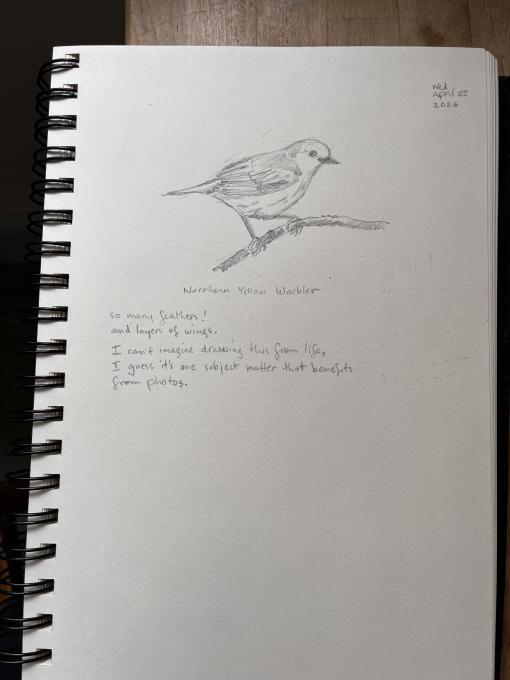
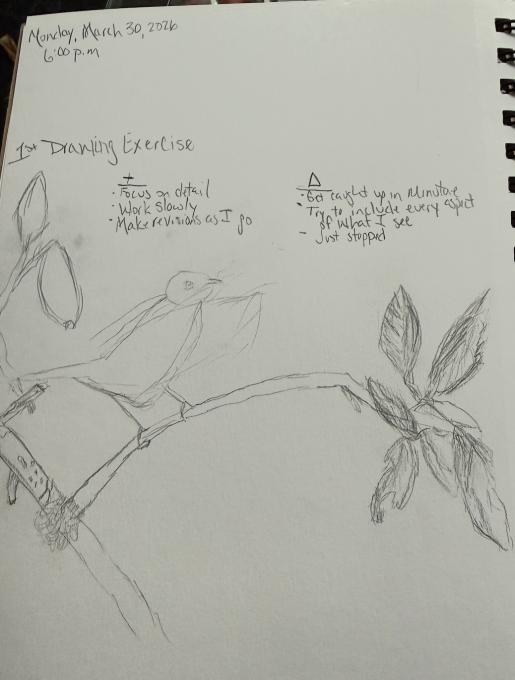
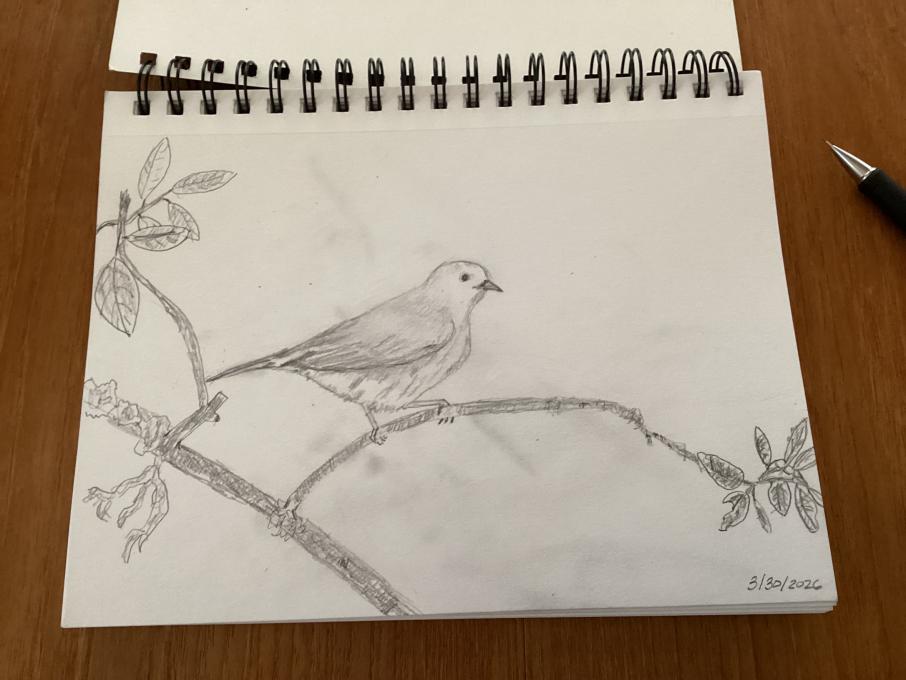
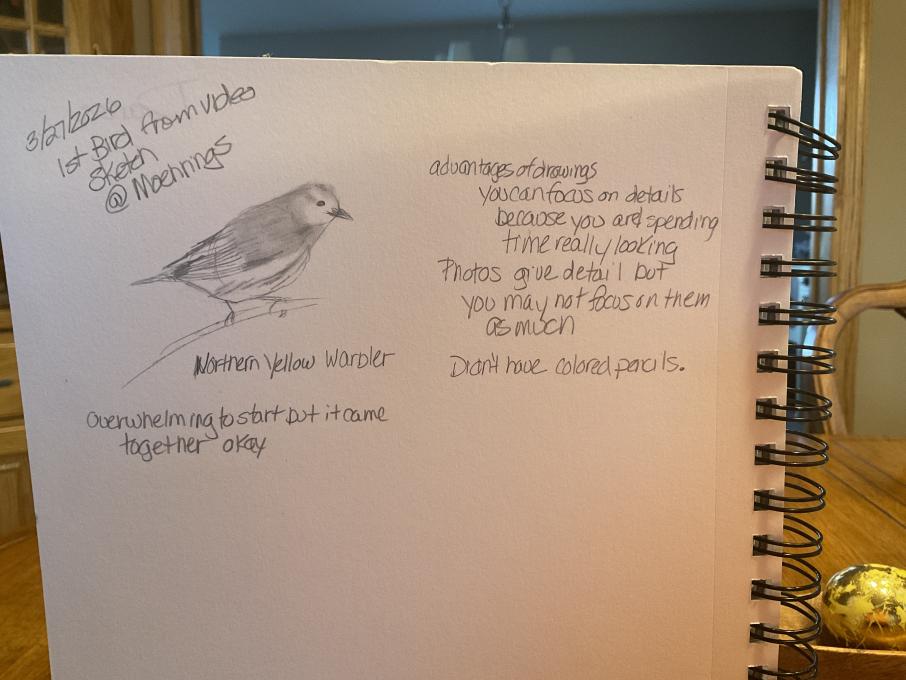
1. It was enjoyable to draw from the photo. I could take my time to depict some detail in the drawing. At the same time it was challenging not to get too lost in the details!
2. I noticed the layering of the feathers, fine details in the beak and the feet of the warbler. This might have gone unnoticed if I hadn’t drawn it. When nature journaling, I guess I could only notice such things after having drawn the same bird multiple times and if the bird is really up close.-
This is beautiful.
-
-
-
I learned more about details of the Yellow Warbler. Difficult including them, though. Colored pencils are challenging to me because when I look closely at the feathers there are a lot of shadows and lines.
-
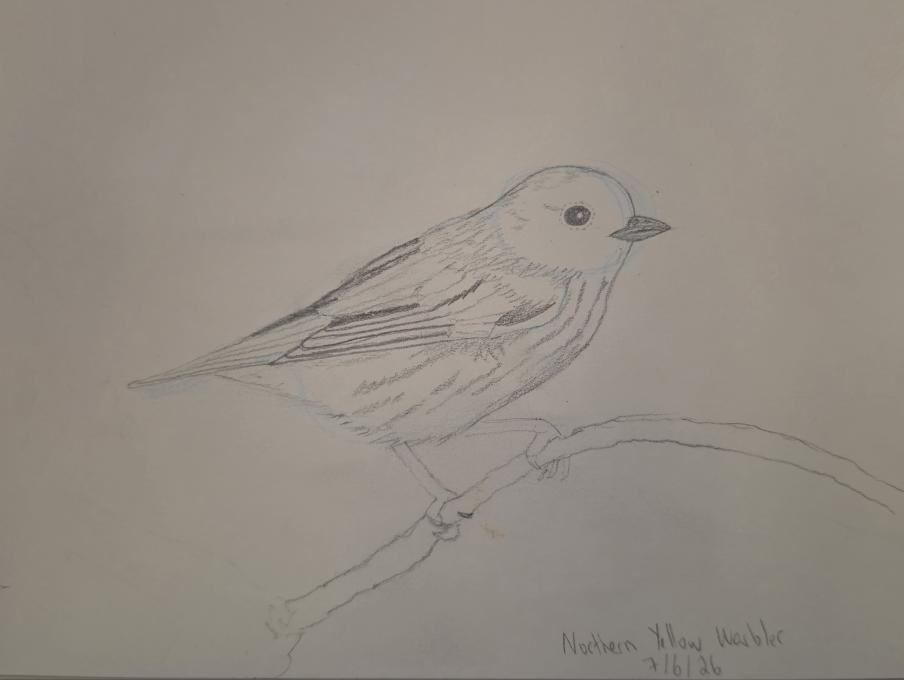
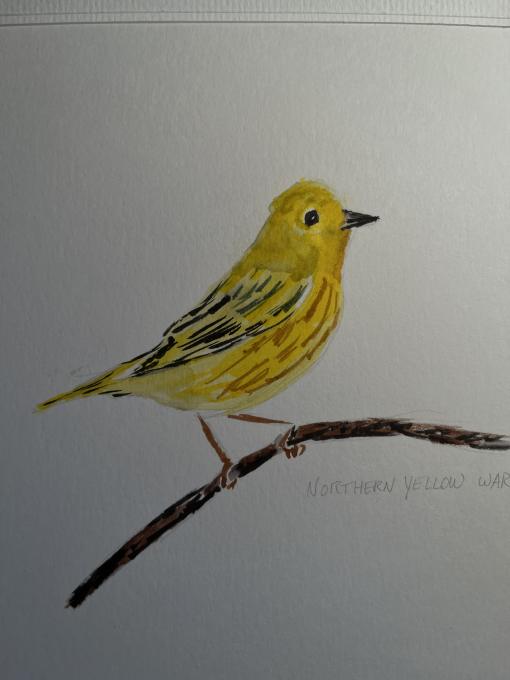
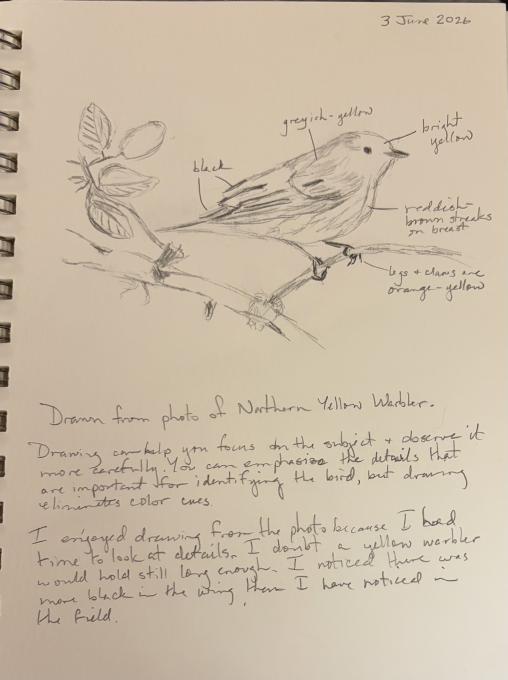
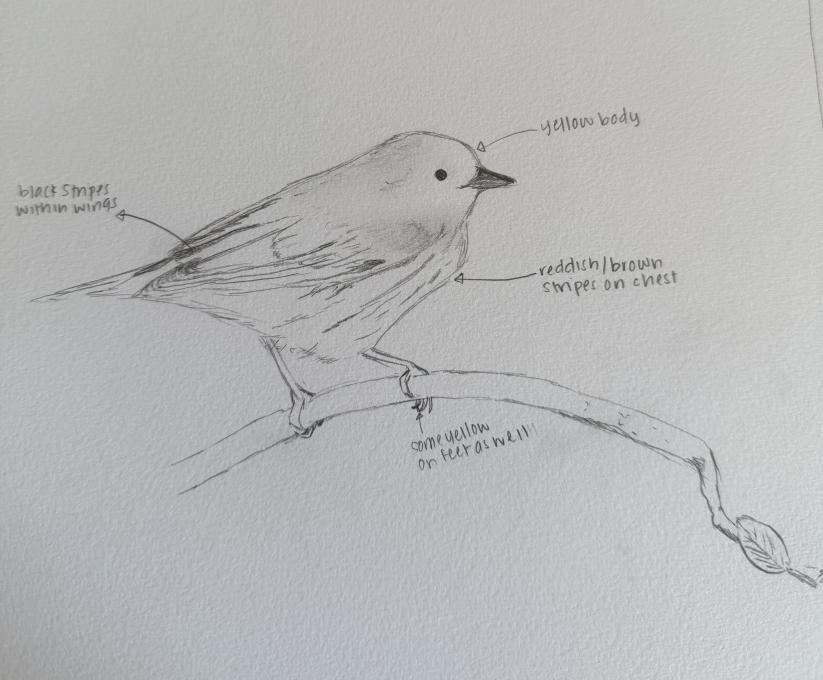
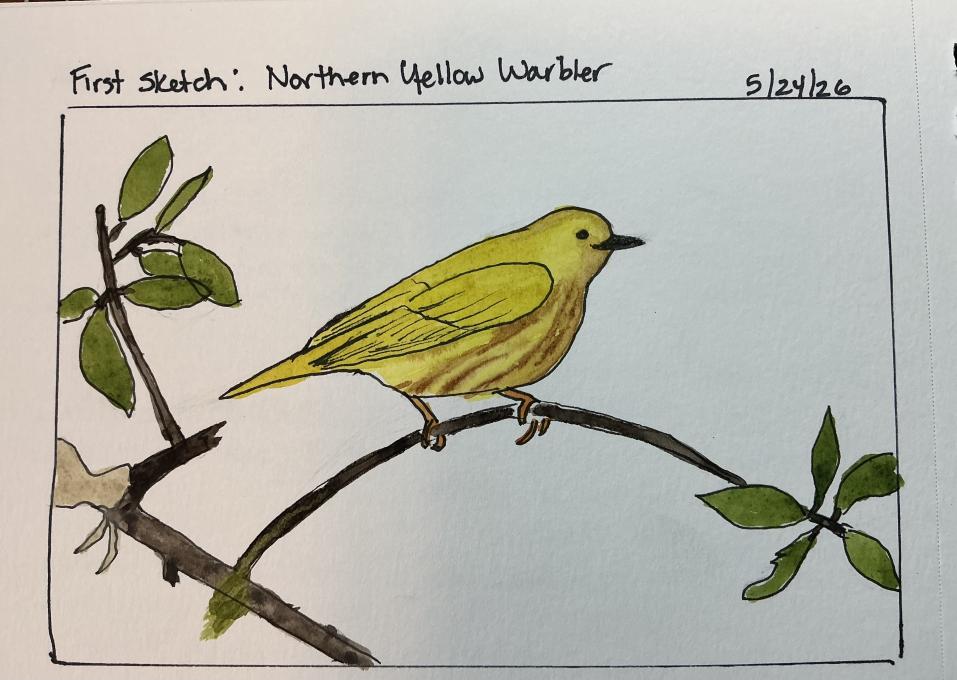 Working from a photo provided time to study shapes and colors, but challenging to get the perspective and angles just right. Hard for me to make the bird seem “alive”, rather than flat with minimal detail. Noticed more of the interesting details of the branch than I would if I hadn’t drawn it.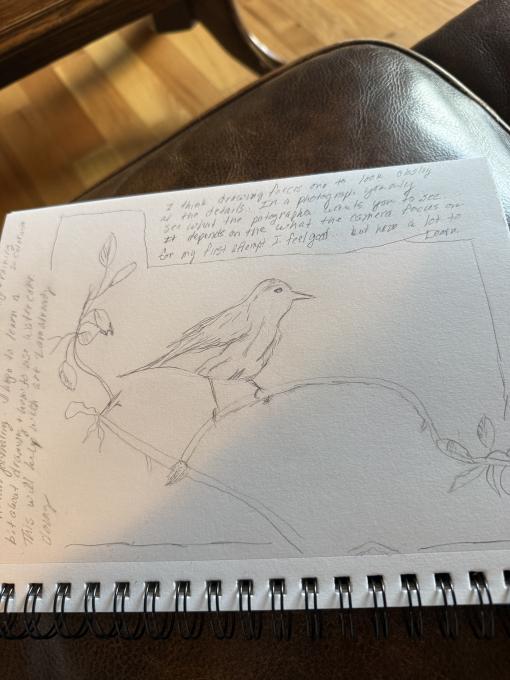
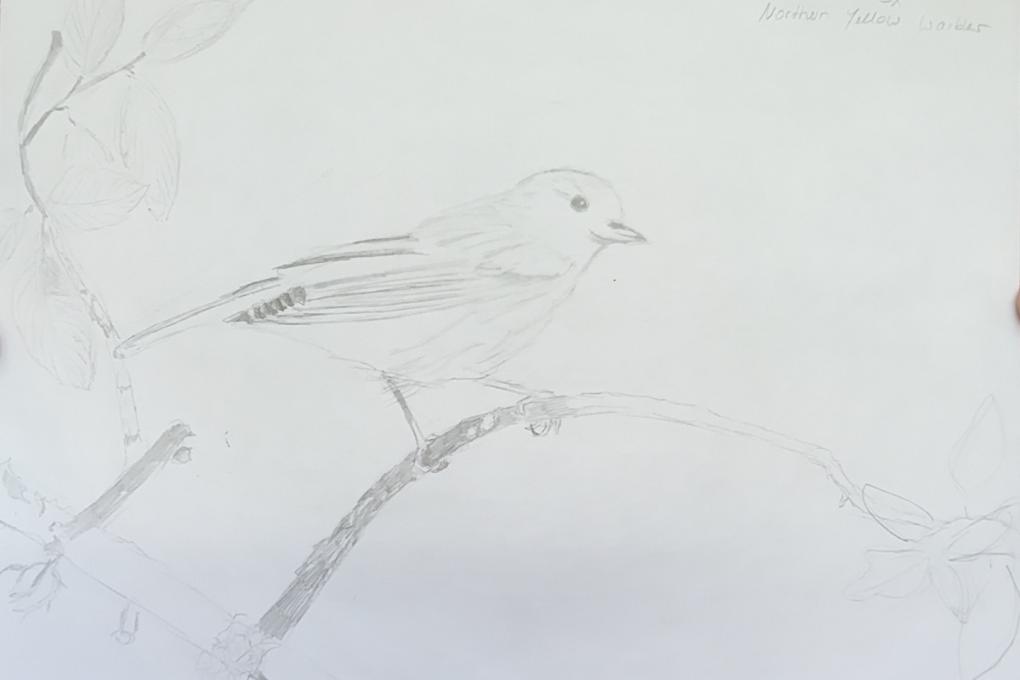
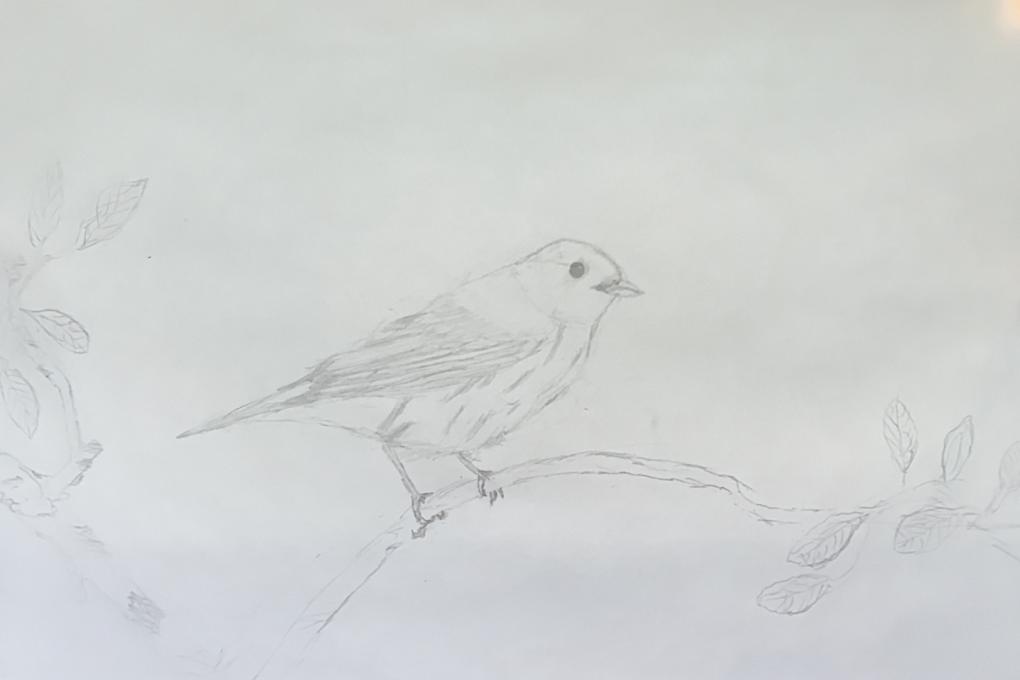 1. the proportions were easier to dray than I would have thought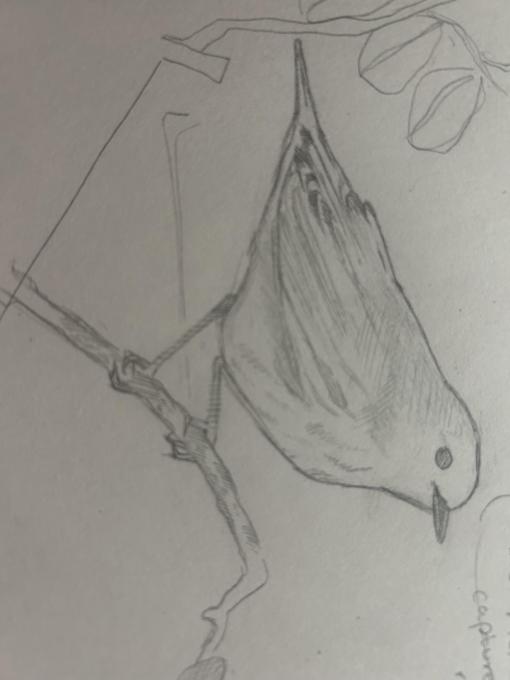
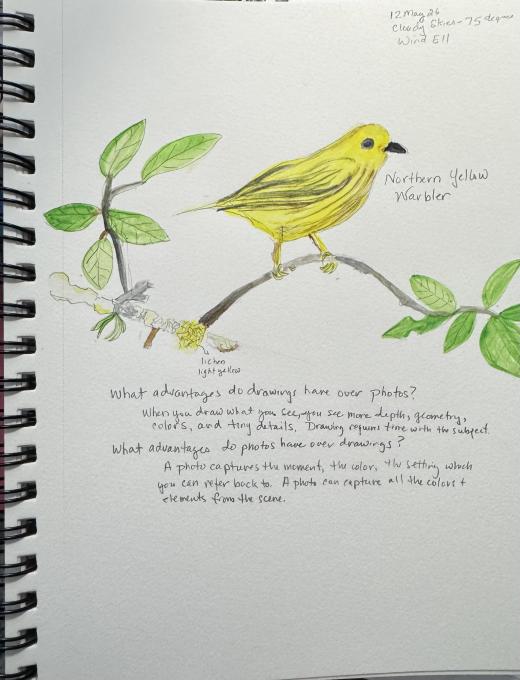
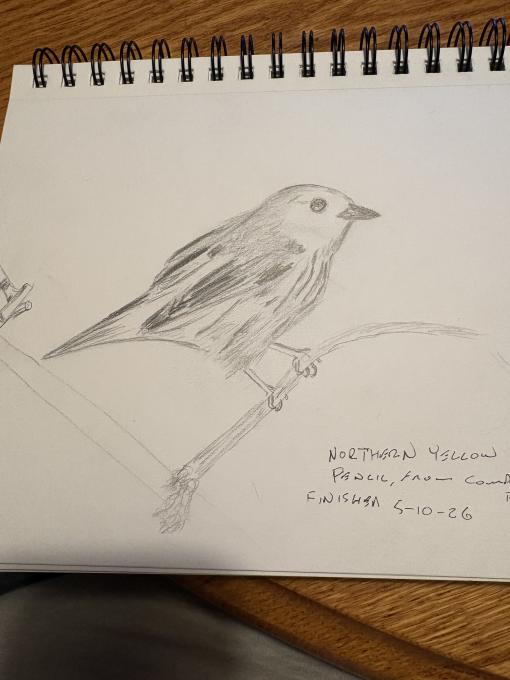
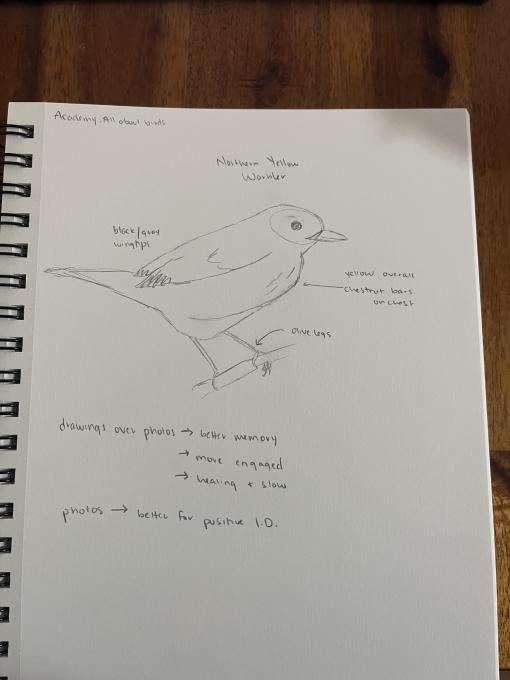
 1. It was enjoyable to draw from the photo. I could take my time to depict some detail in the drawing. At the same time it was challenging not to get too lost in the details!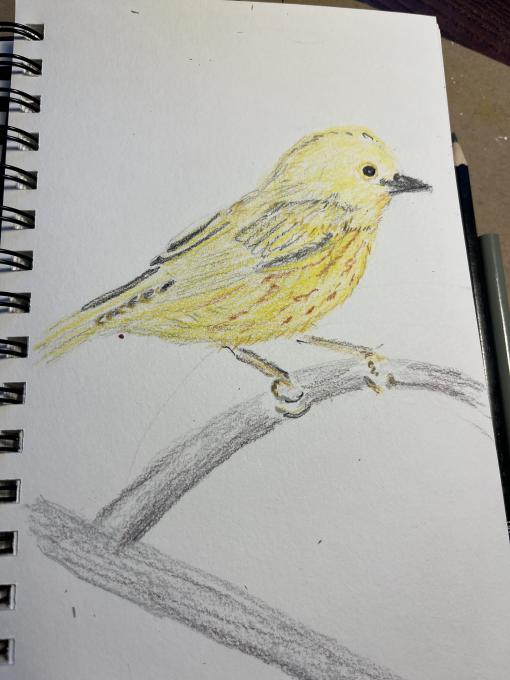
Read More: