The Cornell Lab Bird Academy › Discussion Groups › Nature Journaling and Field Sketching › Jump Right in!
-

-
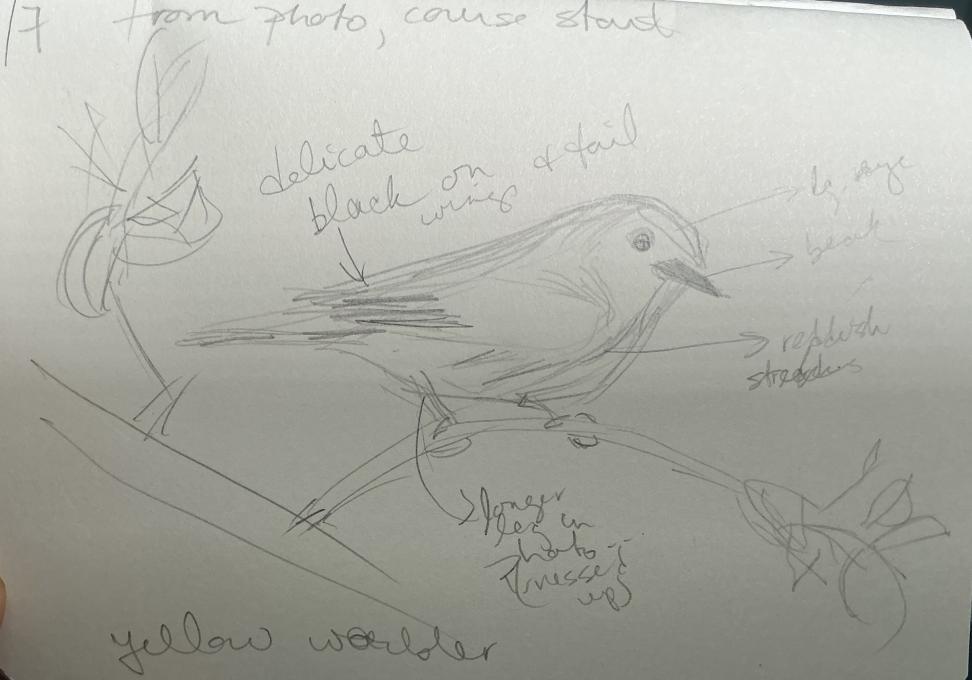
I think that getting the shape was easy enough, by which I mean it was easy enough to do crudely! I think the thing that was the most challenging was getting the wings right. I feel like wings are incredibly complicated for me. But there is an advantage in that difficulty. That is, I think that I'm more attuned to what I'm seeing in the field because I'm more fixated on getting the details right. One thing that I noticed about the wings of the Yellow Warbler is that the they are studies of yellow and black...I noticed how those two colors seem to be the most prominent, and I don't think I've ever noticed that before...I noticed how the back seems to be prominent in the primary coverts (?I think?)
Also, I think the advantage is you can see how much you're missing, too...I don't think you can get everything in, but I note how my vegetation is pretty rudimentary. In some ways, this might testify to how much we are always missing at all times.
I also wonder about the photograph...I started out photographing rather than sketching, and I feel like I'm anxious over moving from one medium to another...would I be able to note some of the things above without a stable photo in view? Is it better to sketch from photos vs. on the spot? Those are questions I find myself considering here. -
-
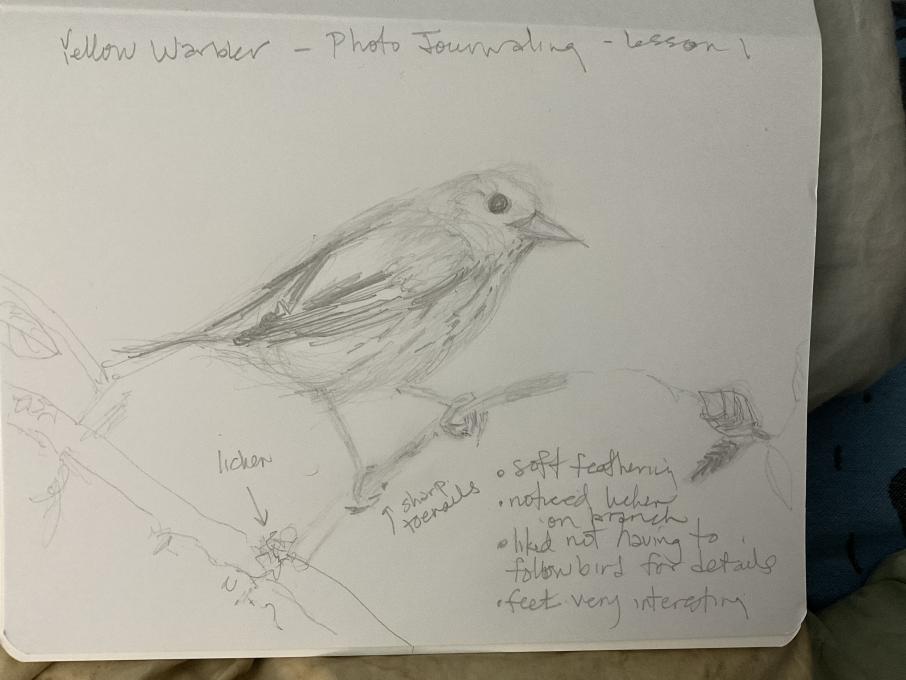
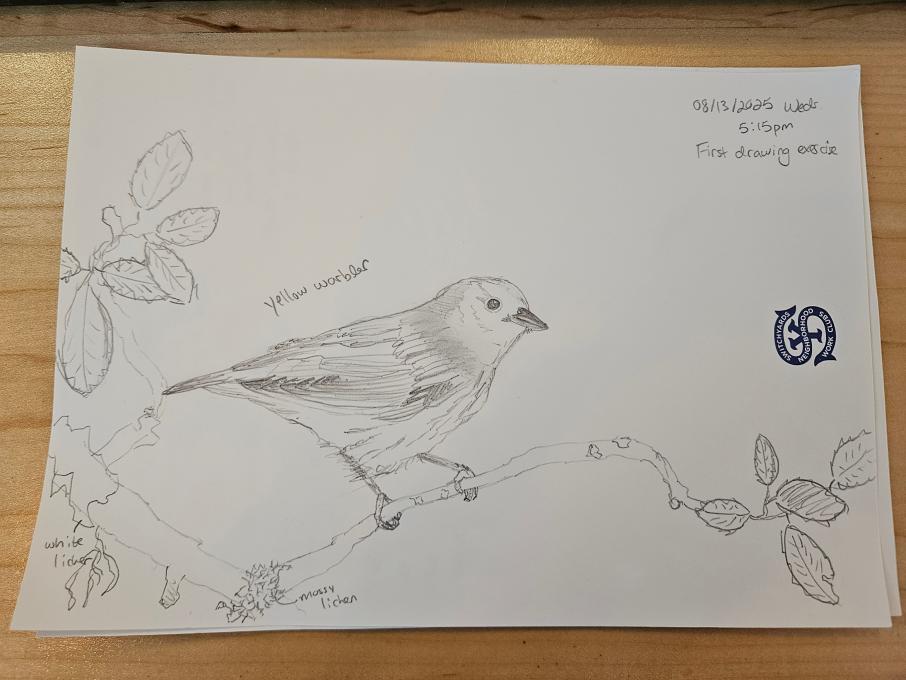
I was excited to pull out my pencil and jump right into a sketch. I'm a little familiar with sketching house sparrows from my backyard, so the warbler came easily, even being another species. The branch turned out to be the trickiest because of trying to get all the little details right. That being said, I wouldn't have noticed all those strange organisms growing on the branch if I hadn't sketched them in the first place! Drawing images really does allow you to take in all details, big and small! Thanks so much, Liz! And also Amy Tan, who, through her book The Backyard Bird Chronicles, allowed me to see the true wonder of observing birds!
-
I don
-
Just drawing itself is challenging. I did like how easy it is to have time to look and then look at the drawing so that I could revise and add things I missed when I began my sketch. I might have missed the detail of the branch and leaves and I certainly wouldn't have noticed the ways the bird's claws hung onto the branch if I hadn't been sketching. I am sure it would make a difference when nature journaling because the details make the drawing more meaningful. I also went to bird academy site and listened to the yellow warbler's song, which made the exercise more meaningful to me.
-
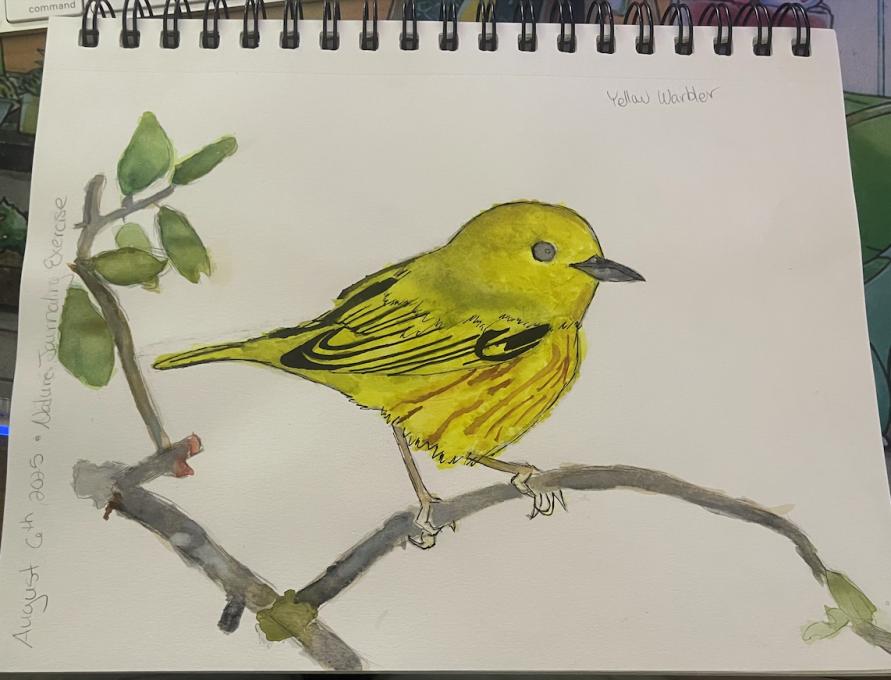
1.) Drawing the bird felt easy, but feeling confident in painting was challenging. Ultimately, I just gave myself license to mess it up instead of overthinking it.
2.) I realized that I could have done more to capture a bit of the setting behind it, even if it wasn't super detailed. Just something to gather the moment a bit better.
3.) I think so, but not entirely. With a moving moment, it'd be hard to capture everything. But I do think capturing more of the setting, noting what tree it was on, even after the bird likely moved, would add to the picture. -
I was grateful the picture was of a favorite summer visitor, and something I was familiar with. The plant material seemed easier than the Warbler. Even though I am familiar with this bird, the shape was a bit challenging and I was glad to be able to look at the photo as often as I needed to and am wondering how I will be able to translate that to actual drawing when I have a subject that is active. -
-
I didn’t know where to start! Began with lines and basic geometric shapes like one of the first videos mentioned. I noticed I wanted to get it “right” at first. Soon though I was immersed in the process and just stopped when it felt right to. It was fun!
-
It's so much easier for me to draw from a photo than from life. The photo holds nice and still! I got the basic shape pretty easily, also the bird's size relative to the branch and leaves. It was hard to get the shape of the bill, the bird's posture, correct colors, and exactly where the feathers were black, greenish or red-orange instead of yellow. I think I got the leaf shapes pretty well, but didn't capture their color or their kind of rough, worn texture.
-
I have a splint on my right wrist and hand after carpal tunnel surgery so a challenging way to start. I struggle with proportion and angles. I learned to draw in high school but never kept up with it unfortunately, a very long time ago.I guess I did ok but I want to improve. I think I noticed the details much more when sketching than I do when I take a photo. I’m going to try drawing some of my photos of birds. I think noticing details will make a big difference for me while nature journaling. I will need to slow down for sure.
-
Wow, it was pretty difficult drawing the bird for the first time. I noticed more of the surroundings, like the branch that the bird was standing on as well as the feather patterns that the bird had. I noticed that on it's bloom area it had reddish/brown feathers, which is something I hadn't really noticed before.
-
1. I felt great about drawing from the photo. I could always look back to check where such pattern went and such feather was placed. I did try not to 'fix' the drawing but struggled a bit.
Note: I did mistake this for a Pine Warbler so that might still be visible in the image 😅
-
I have only done 1 follow along water color but I figured I’d give it a go. I aimed more for leaving perfection at the door and focused on what caught my eye more. Cameras have the advantage overnight freezing life in a moment. We have the advantage over full perspective and getting a larger more detailed understanding.
-
I used to draw, but this is the first time in many years that I have sat down to draw for the joy of it. I felt happy and peaceful, like I have returned to something that was missing from my life.
Drawing is good for really getting to know a subject. It forces you to closely observe and notice details. It focuses attention. It is an opportunity to dwell with the subject, appreciate and even fall in love! -
1. I felt intimidated about drawing from the photo. The challenging part was just starting and not fearing imperfection.
2. I may not have noticed the color variation in the breast and wing of the bird. Also the algae (maybe) growing on the tree branches. -
1. I enjoyed drawing this bird! It helps that warblers are my favorite type of migratory bird! The easiest part was getting the body ratios (mostly) correct. The most challenging part was figuring out what the gray gradient variant of the bird's yellow body was.
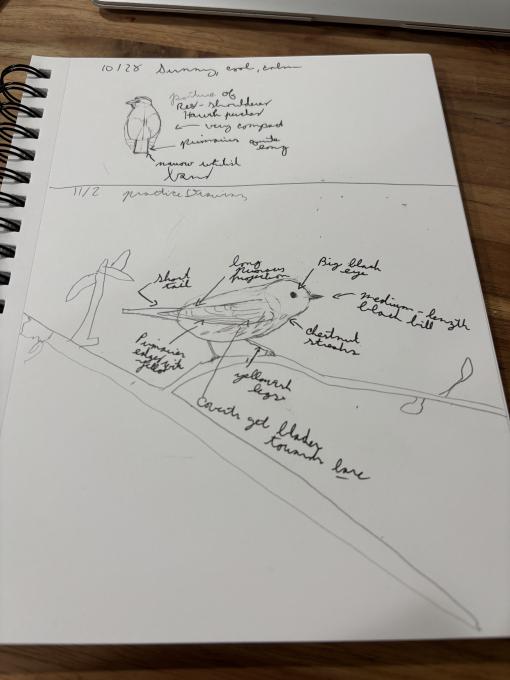
2. Their tail is surprisingly short for how plump their body is. I didn't notice it until I realized my outline was slightly off; I kept making the tail too long in comparison to their body. I think it wouldn't make a huge difference if I captured the vibe correctly. -
I was a little intimidated trying to draw a bird right off the bat. However, I don't know that I could draw one in real life as it would be gone to quickly. The act of drawing always emphasizes the "seeing" so it always brings more detail to mind. In this case, the darker streaks are distinctive. I wonder if they are individual to each bird or are they relatively consistent for the species? This was also the first time in 50 years that I'd used watercolours so I messed that up a bit.
-
I often draw from photos, so I didn't mind this exercise. I did find myself fixating on getting the shape of the beak right and maybe if I were drawing from life I wouldn't have the time to focus on little things like that. After looking at the photo for a long time I noticed slight changes in feather texture and color that I wouldn't have noticed otherwise. Specifically, I noticed the rust colored streaks on the breast. If I just briefly looked at the photo I would have only noted the yellow and black feathers. For me, one of the points of nature journaling is to notice details - colors, angles, movements - that I wouldn't normally see. So, I think if I saw the warbler out in the wild, I'd like to draw the differences in the feather colors. However, realistically, it's probably pretty hard to detect subtle color differences when you're drawing a bird that's moving around. So, perhaps nature journaling is about noticing detail, but also capturing a moment and the movement of an animal rather than every little specific thing.
-
The emotional journey of drawing this photo was from "uh oh, this will be bad" to "...ok..." to "I remember how to do this!". It was satisfying to see the little guy emerge and I'm happy with its personality. Proportions and deciding where to start are always challenging for me, but it was easier than I would have expected to make adjustments when I felt like something was off. (Glad I had an eraser.) If I wasn't asked to draw the warbler I probably wouldn't have noticed how some of the patterning and colouring is very soft, while some is very stark and sharp.
-
I surprised myself, it looks like a bird! By drawing (rather than taking a photo) I noticed the wing and tail feathers were in multiple layers.
-
It was fun! It was challenging to get the shape of the bird without tracing it. It was easy to make it look like a bird by the end. I wouldn't have thought about the unique shape. It had heart shapes and triangles. Yes, nature journaling will help us notice details we would normally rush past.
-
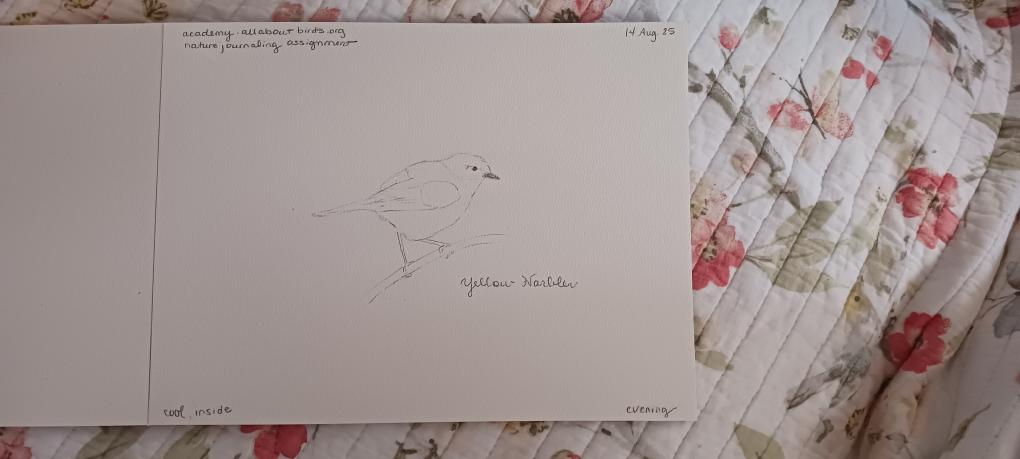
hard to imagine doing this with a moving subject! the legs were the trickiest for me. noticing the feather directions and patterns as well as the small face details are some details i might not have noticed if i weren't asked to draw it.
-
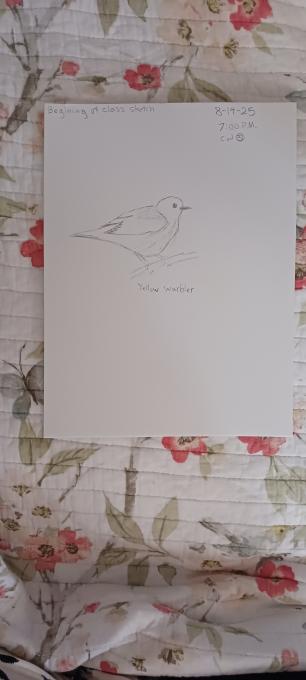
It was challenging I tried to pay attention to proportions which are difficult for me. I am looking forward for some instructions to help me.
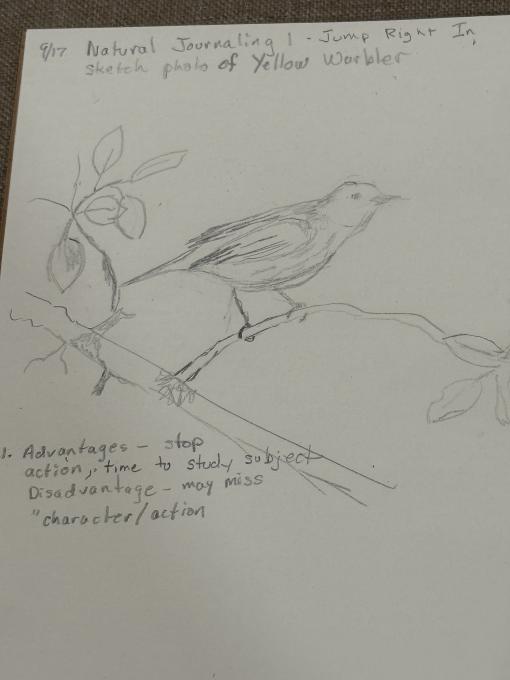
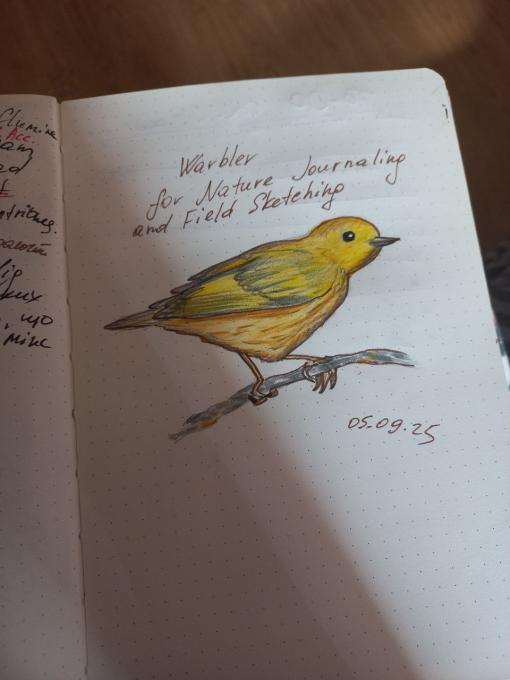
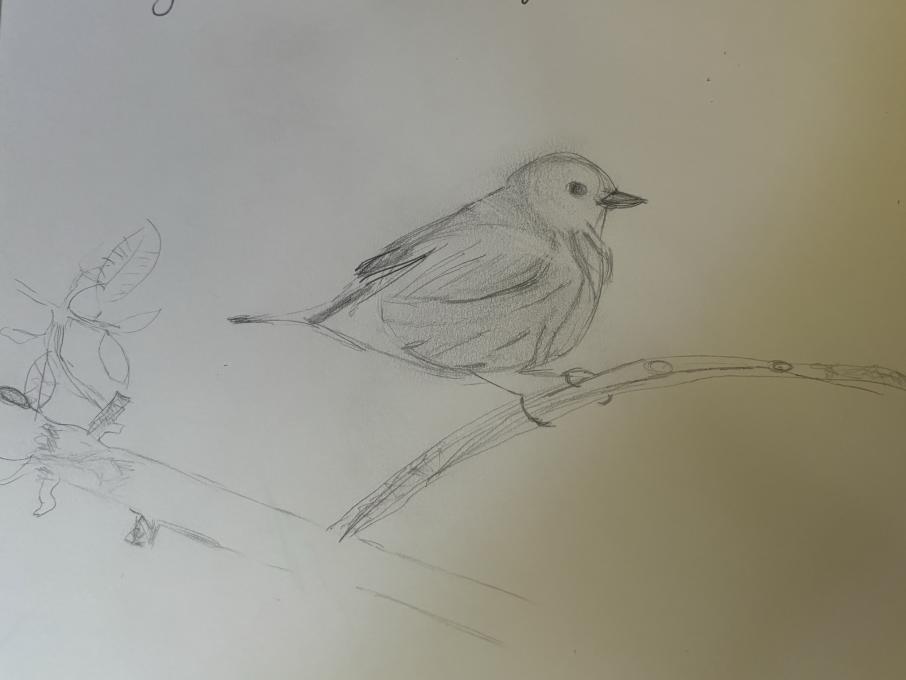 I didn’t know where to start! Began with lines and basic geometric shapes like one of the first videos mentioned. I noticed I wanted to get it “right” at first. Soon though I was immersed in the process and just stopped when it felt right to. It was fun!
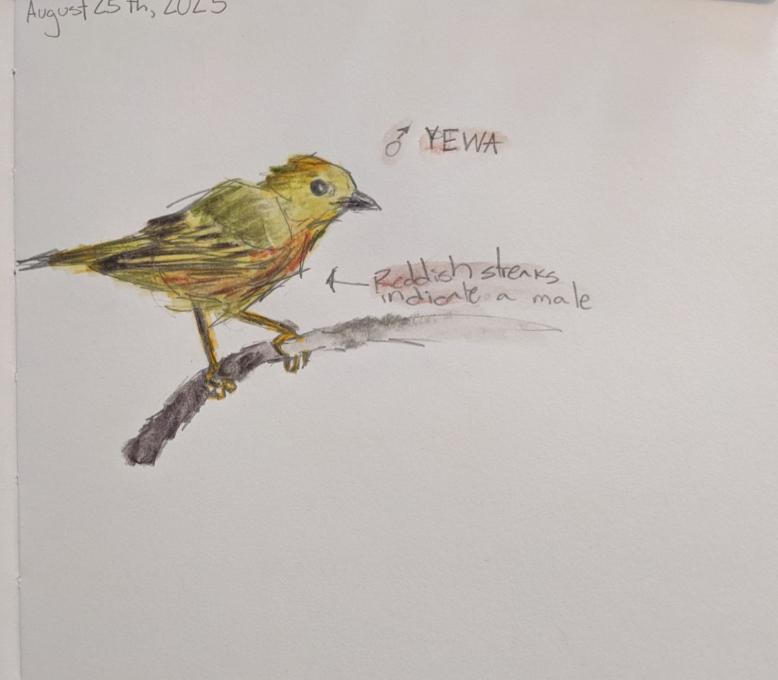

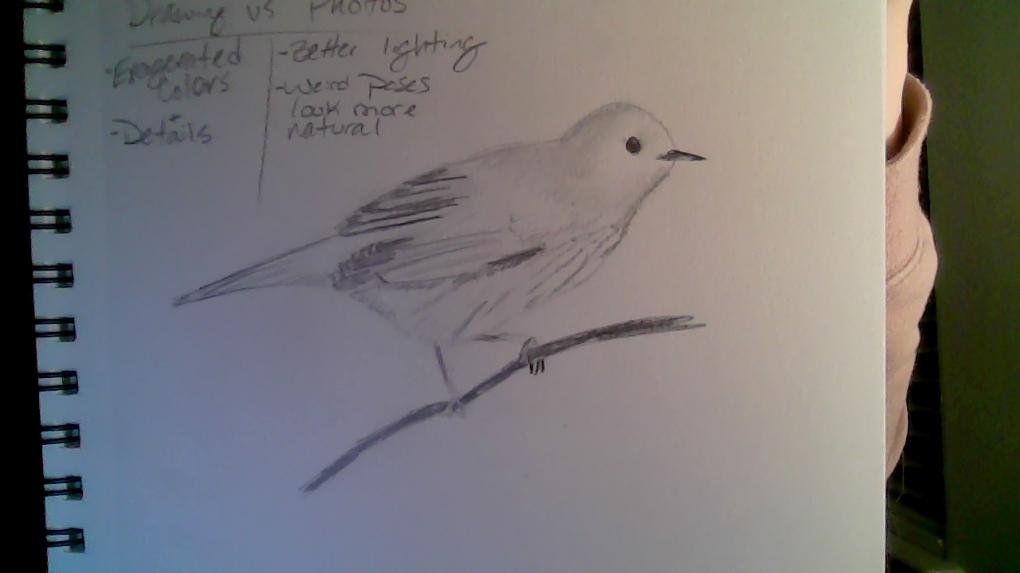 1. I enjoyed drawing this bird! It helps that warblers are my favorite type of migratory bird! The easiest part was getting the body ratios (mostly) correct. The most challenging part was figuring out what the gray gradient variant of the bird's yellow body was.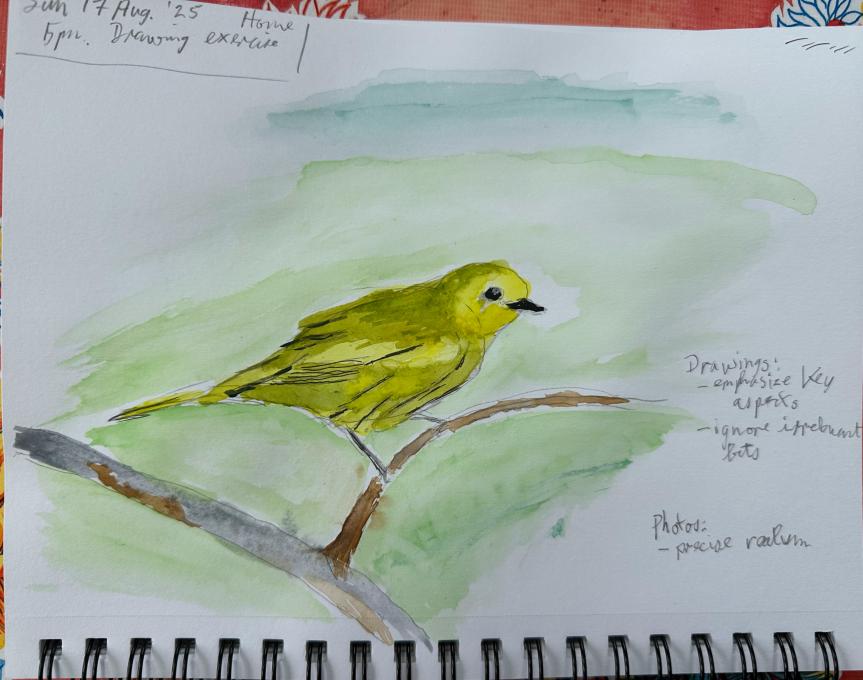

Read More: