The Cornell Lab Bird Academy › Discussion Groups › Nature Journaling and Field Sketching › Jump Right in!
-
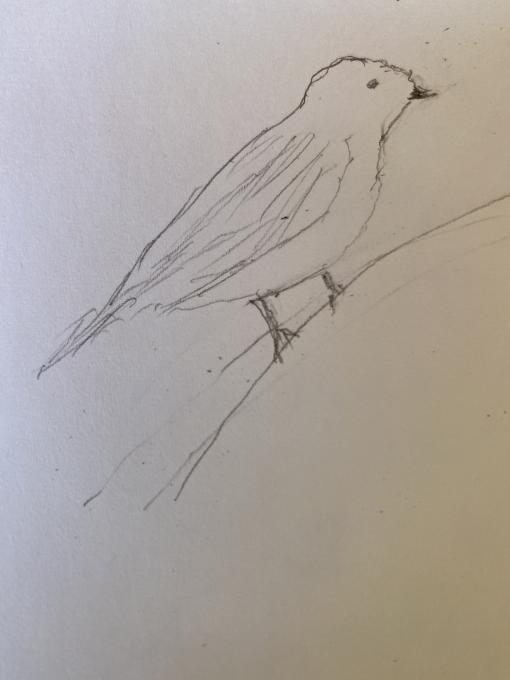
Drawing from the photo really made me appreciate the small details of the picture such the structure of the bird and different textures in the image. I felt more connected to the bird from drawing it and really focusing on its shape, eye and beak placement, feathers, feet, etc.
-
-
I really enjoyed the exercise but I found getting the proportions right was challenging. I liked the chance to slow down and observe more. I noticed how the black feathers have a white scallop approach. I think the drawing makes more memories than taking a photo.
-
I really appreciated the chance to slow down and notice details that I rarely do in life or by taking a photo - the size and depth of the beak, it's proximity to the bird's eye, the proportion of the body. Getting proportions right is especially challenging and really trying to 'see' the bird's anatomy.

-
It was challenging to get the fluffiness of the feathers and accurate shape of the bird. I might not have noticed if i weren't drawing it how you can notice the individual feathers on the wing tips and the angle of the legs and how the warbler grips the branch. If I were doing this drawing in my nature journal i would want to capture the stance of the bird and the angle of the legs - also its habitat.
-
I had to correct my placement of the back leg/claw--initially, I had the two too close together and the warbler surely would have wobbled and flown away. It made me appreciate the physical laws of balance and support. Likewise, I initially had my circle for the head too close to the body--I needed to extend it to help my warbler balance. Yes, noticing, analyzing and drawing the correct proportions and angles make a difference for nature journaling.
-
-
I liked being able to jump right into the assignment even though it felt a bit intimidating. I appreciate this being a place where sharing is OK regardless of how good one is at drawing. I struggled with getting my overall proportions right, but it was a lot of fun. I have photographed landscapes and wildlife for a many years so working from a photo felt comfortable. It will be interesting to see how I manage when observing and drawing birds in their natural habitat. I wouldn't have noticed the lichen and how the light played on the leaves if I had not been asked to draw this. I'm really looking forward to incorporating what I learn here in my nature journal.
-
-
it was fun!
get stuck in, no procastination lol
just to give it a try was enjoyable,
i cant upload pictures however seeing others efforts really assured me that its okay.
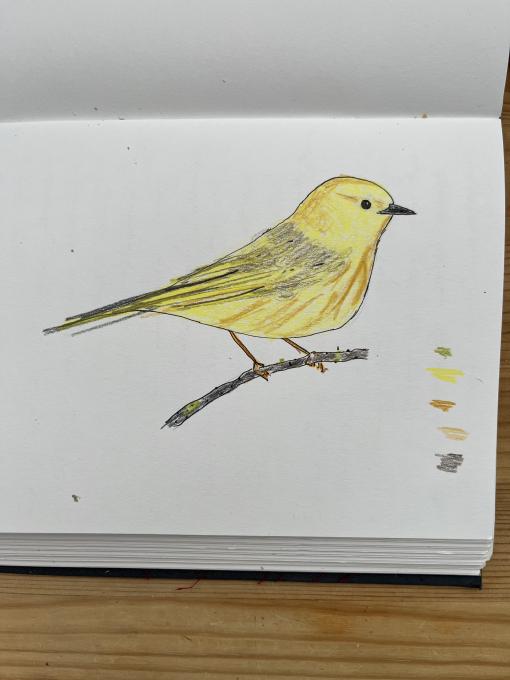
even with cheap colour pencils i enjoyed mixing the green and yellow and some red.
the questions helped me reflect on details didntm quite see on first or second doing
thanks for getting my feet wet -
Using a picture allows one to spend as much time as needed to observe and try to capture the image. I was able to focus on the overlay of feathers and the textures of the branch and leaves in detail. I can imagine how difficult this sketching would be if the bird was live in nature. I too am waiting for supplies to add color.
-
Tried to move quickly, but I got bogged down in details and wasn't thrilled with my watercolor work. I'm not patient enough to let it dry completely before layering. I tried to spend time on shadows on the bird and the leaves - something I don't spend a lot of attention on when I take a photo. -
Having a photo allows me the luxury of a still subject. I sketched in about 45 min and then used colored pencils. I do not think an animal will pose for so long! Now I am more comfortable with the markings of the Yellow warbler than I would have been otherwise. I have had a hard time remembering who has a rounder body warblers or wrens. Now it is more firmly in my mind that warblers are more slender. That will help with ID in the future. Also the beak is fairly short but not as stubby as wrens, I have not gotten my paints or journal yet so I am doing pencil 2B 4B and 3H. I plan to go over it with colored pencils tomorrow as it is way past bedtime!
-
I am still waiting for my pad, watercolors, and Pentel pencils to arrive but I was anxious to get started so tried sketching on an old pad with a regular #2 pencil. I haven’t drawn or even sketched anything in many years and think I need a LOT more practice! I didn’t mind drawing from the photo. I have tried sketching deer in my yard in real time but found it very challenging because they move so often. This is something I really hope to improve. Birds would be even worse I imagine as they are fast! Sketching wasn’t too hard but getting the correct proportions was much more difficult. There were many things I noticed when drawing that I prob would not have noticed by just looking at a photo like the lichen on the branch, the scalloped edges on some of the leaves, the slight ring around the warblers eye, and the reddish stripes on its chest. Yes, I do think it would make a difference when nature journaling especially when trying to ID birds. Coloring and habitat all come into play for that.
-
This is the picture of the yellow warbler. It took me some time to draw and then color; I cannot tell how long. Lately I have been drawing some birds following a step by step process, using a book I borrowed from the library. I tried to follow the same process, but still found that challenging. I think the beak ended up too wide. When doing the journal in the field, I think I may need to just sketch as it takes a long time to draw and color; I may complement with a picture I take with my cámara to do the finishing tasks afterwards. My notes are in Spanish as that is my first language.
-
It seems that this would be easier than drawing from a living, moving bird. I noticed how the feather groups are layered. The proportions of the bird turned out pretty well, but I draw slowly. This will be a challenge when drawing in nature.
-
I really enjoyed drawing from the photo. I haven't drawn anything for many years- it's like waking up. The process definitely made made me more attentive to the image than I would otherwise have been.
I am wondering how it will be to draw outside... -
I gave myself a time limit on this task as I know I have a tendency to obsess with details, but really enjoyed drawing it and seeing everyone else's. I loved the colours in the image, particularly the beautiful yellow of the bird contrasted against green background - I'd love to learn how to add this to my drawing on this course.
I think that perhaps a drawing allows you to really focus on detail but in real life you might get some better feel for gestures and the character of the subject? -
Drawing from a photo feels safer and in some ways easier because it's a still image, and I really had time to examine the details. I'm trying to learn how to sketch more quickly. Getting the overall composition felt doable but getting the proportions of the warbler was tough! I don't think I got it, especially when I look at the the negative space under the tail. It's completely off. If I had been outside doing this sketch, I don't think I would have noticed all the textures on the branch because I would have been focusing on trying to sketch the bird before it flew off. I also might not have noticed the red/ brown markings on its chest. One important thing I learned about my sketchbook is it's orientation! I couldn't fit everything in because I drew it vertically instead of horizontally. -
I felt this was going to be challenging without any upfront instruction and certainly intimidating. I have practiced a bit previously with drawing bird shapes but have never quite gotten the hang of sketching them easily. I am interested in learning more about observing shapes in nature and being able to confidently draw in the field.
-
-
1. I was was anxious about starting, but settled in as I started drawing. I found proportions and positioning to be challenging. I was pleased to figure out the general shape quickly.
2. The different kinds of feathers on the warbler’s body like the soft belly and well defined wings. The shape of the birds legs and feet and how gracefully it holds the branch. Spending more time engaged with nature and to notice more of these kinds of details are exactly what drew me to nature journaling.
-
At first drawing from the photo was intimidating but once I got started it wasn’t difficult and I enjoyed it. I do a lot of my drawings from photos and find it easier than drawing from life. The beak and head shape were challenging. I’m not sure I would have noticed the details on the branch if I hadn’t been asked to draw it.
-
-
1. Mostly intimidated! I didn't know where to start. Surprisingly, the bird's body was easy, but I found the growth on the branch and the shading to be most difficult. 2. I didn't notice the reddish color on the underside of the bird until I started drawing it. Noticing little details you wouldn't have is probably why most people are taking this course! So that's a good start.



Read More: