The Cornell Lab Bird Academy › Discussion Groups › Nature Journaling and Field Sketching › The Power of Comparison
-
 I decided to compare 2 beetles. They had more differences than similarities. I made a table with some info about them.
 -
I like your study and table very much
-
@Isabel Thank you so much. It took a long time to complete, but I learned a lot . I really enjoy reading and seeing other student posts!
Avery
-
The beetle study is just sooo pretty and I don't like beetles! Did you use watercolor or watercolor pencils?
-
@Deborah Hi, thanks so much. I mostly used watercolor and some thin marker in tight dark places.
-
-
I haven't done many comparison studies, but I have done some. I thought the comparison study helped me focus better on the unique characteristics of the black-capped and the chestnut-back chickadees that I was comparing, and the similarities between them. I learned that creating a comparison study can help you distinguish different and similar characteristics about two different things.
When balancing drawing and writing in my journal, I think I will balance them depending on what I want to do that day, and what I want to write/draw about. -
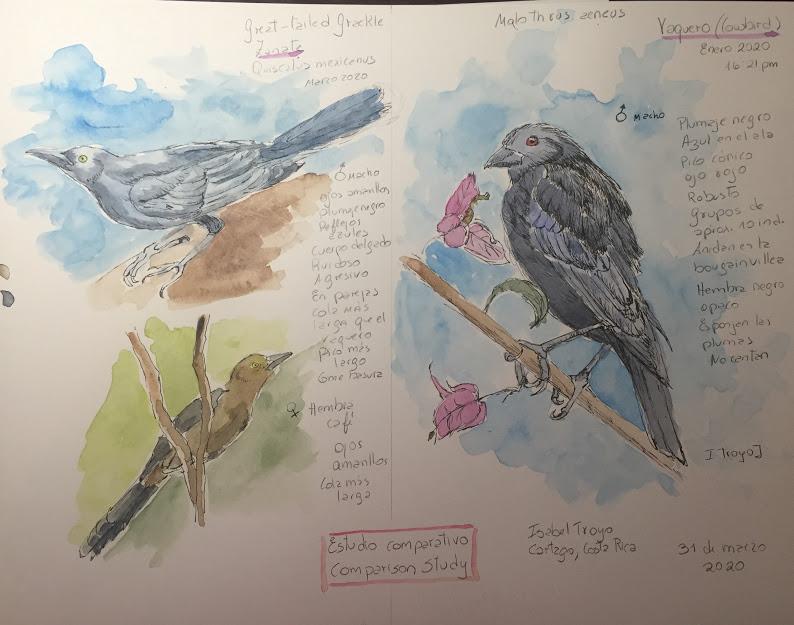
I have been observing this two different bird species for three months. Both are black and nest in the bougainvillea in front of my house. When I made this comparison study I notice that the Great-tailed Grackle (left) has yellow eyes, is bigger with longer tail and beak than the Cowbird (right). Maybe he has a stronger beak so he can eat anything, he can eat from the garbage bags. The Cowbird is chubby, has red eyes and is not aggresive as the Great tailed Grackle.-
Very nice watercolors and study!
-
Beautiful bird renderings!
-
I'm captivated! Beautiful!
-
I appreciate these watercolors of birds that I have so often seen.
-
-
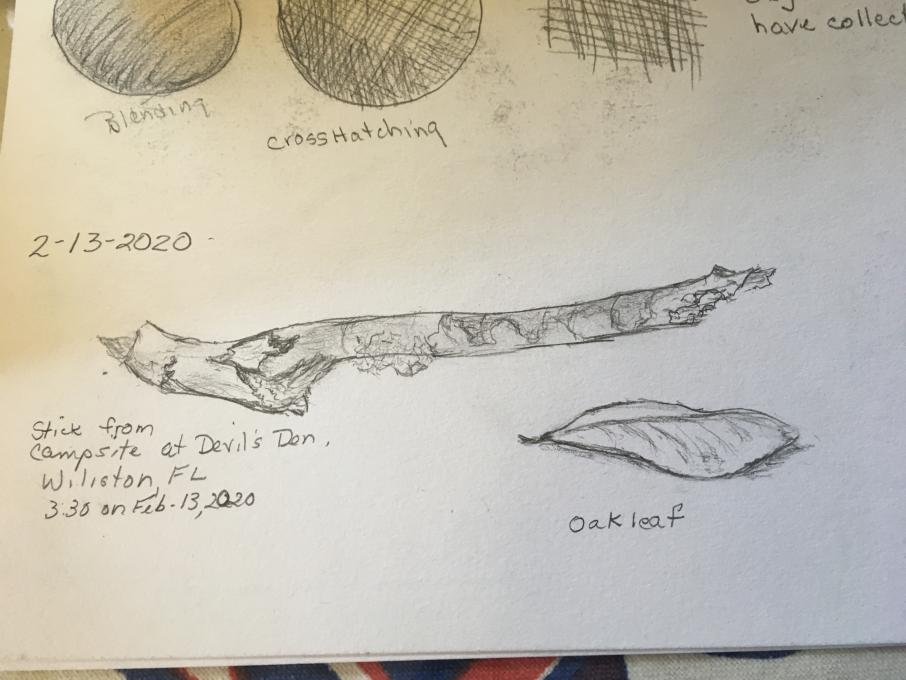
We were in Florida back in February and we were camping at Devil’s Den in Williston . The days were warm and I sat at a picnic table and drew these two items. They have totally different textures and I was trying to use the hatching, contour hatching, and some scribbling in this exercise. I learned that these techniques help to convey depth and texture like whether something is smooth or rough.
-
I compared the leaves of three backyard plants. The rhododendron and the laurel were very similar and symmetrical while the azalea was quite different with a rather random, but connected series of paths, suggesting that the laurel and rhododendron might be related. The actual rhodie and laurel plants themselves are quite different though and the laurel shape is more closely related to the azalea in shape with multiple stems coming from the ground rather than one or two stems rising with multiple off shoots like the rhodie.
-
Great toi have a chance to record and define what I see.
-
Just exactly that..I need to focus to even see the differences. It’s a discipline thing.
Drawing , writing, recording come naturally if you are concentrating on only one or two items.
the short notation with a dot before it works for me interspersed with the drawings.The research that follows, the questions asked are equally important to me.
-
I finally completed my comparison of the Junco and Chickadee both of which frequent our feeder. I am still not drawing from the real thing - this is from the Sibley Field Guide but it did allow me to really see the differences in their form and to focus on differences in behaviour. No modelling in the drawings but maybe I will do that later. Scribbling is useful.
-
I have a small grove in my garden is covered with Lesser Prewinkle. Only two yards from it, Balkan Anemones have been conquering the gravel path. The flowers of both plants have a very similar purple violet color and the plants are also similar in height. ( a few inches) . But all the rest is quite different: I noticed different shapes of the leaves (shiny and single /opposite and smooth edged versus mat and composite/ dented). Flower stem were bold versus hairy. The five petals of the Prewinkle merge into a tube shape at the base of the flower with five sepals. The Anemone has about fourteen petals, but I couldn’t find any sepals! This triggered my curiosity and after consulting some botanical websites, the mystery was solved: The ‘petals’ seem to be false and are actually colored sepals! This was a true eye opener. Without this drawing excercise, it would never come to my mind that I was looking at a flower chalice..
-
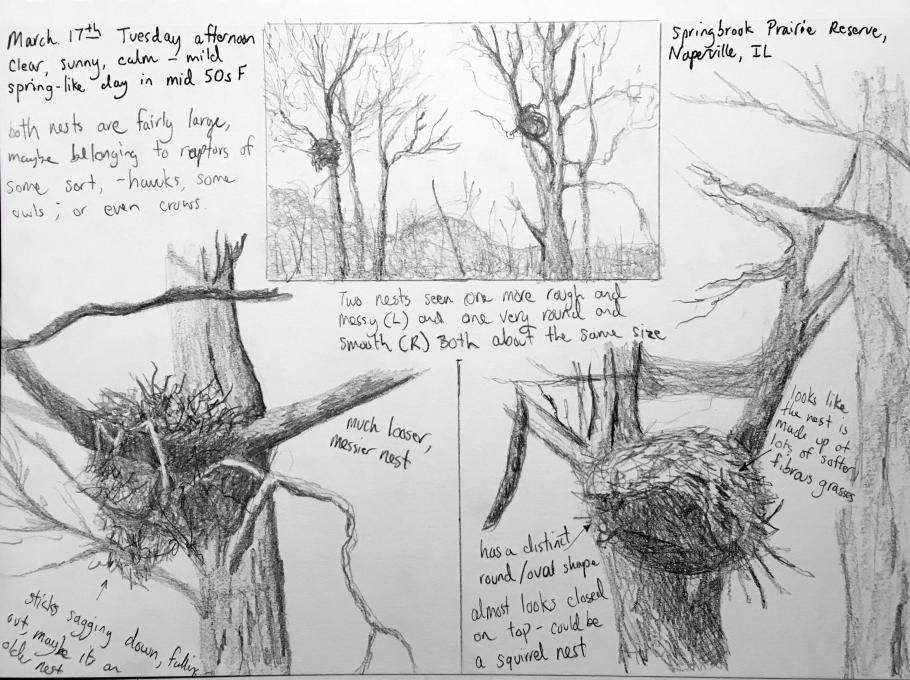
Finally getting back to the class after a longer hiatus during the holidays that expected. For this exercise I studied two nests, it was a good way to make more focused observations than just looking at one object.
-
Your nest drawings are wonderful. I find drawing nests very challenging, because even though they appear messy, they actually have organization and symmetry. You did a great job! 👍🏻
-
-
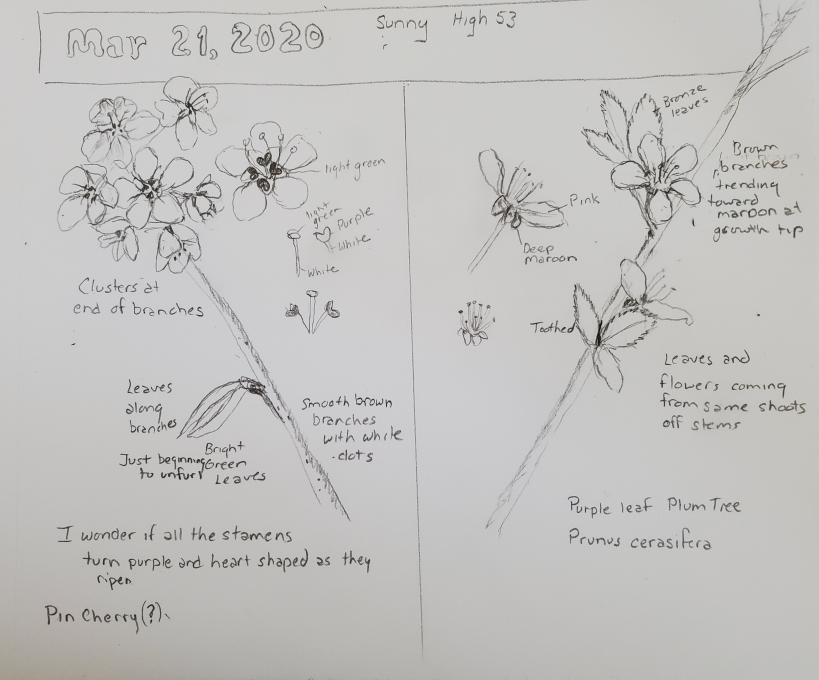
This exercise helped me really observe the different attributes of the two types of tree flowers. I think it will help me identify species.
-
It is still too cold to do anything outside here, where I live. I collected a group of tiny coniferous cones that were all attached together on a branch (group of branches) on the ground where they had fallen, and used these in a comparison with a larger pine cone. The pine cone was a little smaller than fist sized and the group of 9 small cones were similar or just a little smaller than the pine cone. I wish I knew what kind of tree the tiny cones were from (they are not hemlock, as I do know what those are like). I honestly can't say what I learned from this, aside from careful observation of details which I think I would have done just from the fact of drawing them anyway.
-
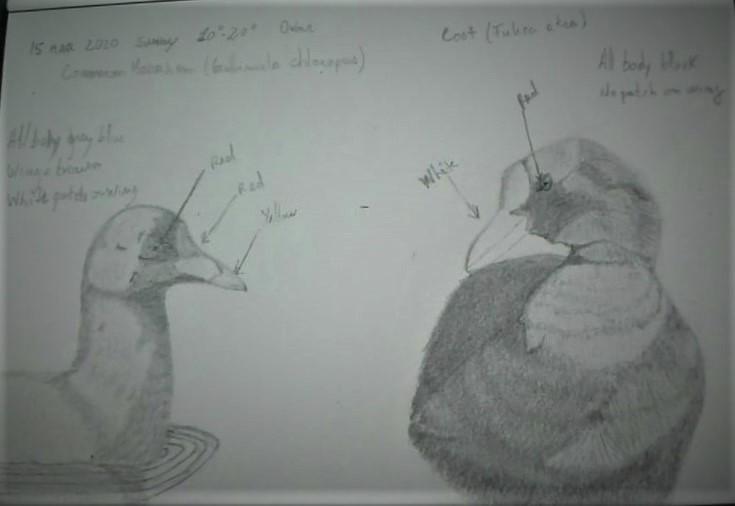
This exercise was not too dificult to do. Focus in the subjects allow me to think more about real structure. I think I made 2 attempts before I was happy with what I saw. Using what is taught, helped me to catch the volume of the birds (at least I think so). I made a list of the birds that will be add in the reply. I don't think I missed any bird.
-
The list of birds observed
-
-
1. A deeper level of detail was observed on each plant during the comparison study. Working back and forth between each plant/sketch provided specific items to look at on each.
2. I like an equal balance of writing/data and drawing in my journal. I feel all provide valuable observation cues and information for reference later. -
-
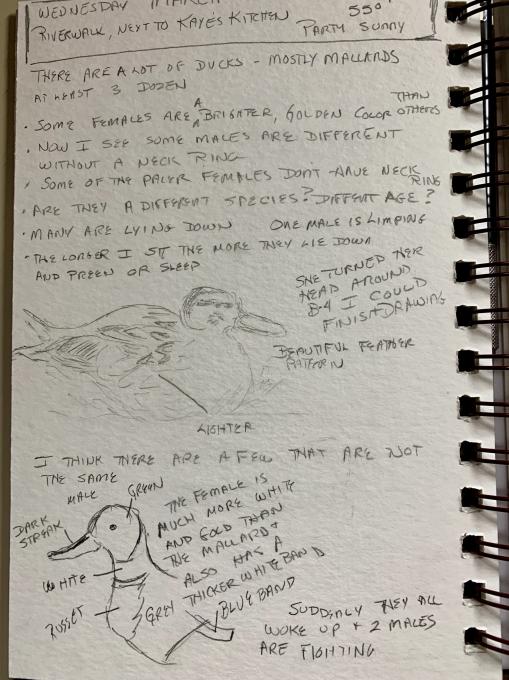
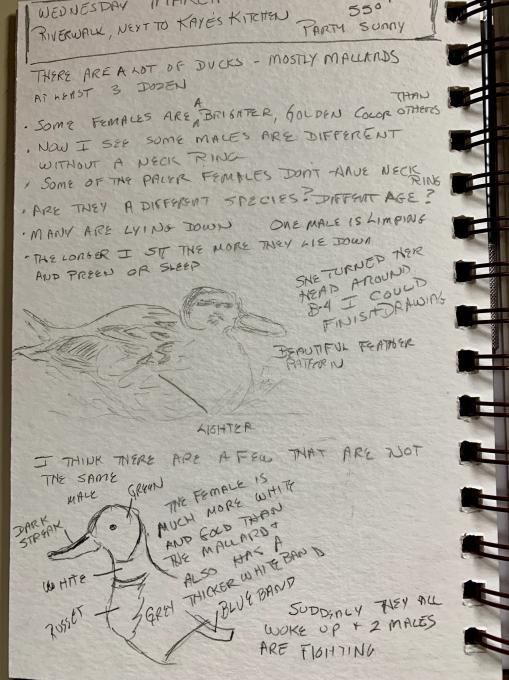
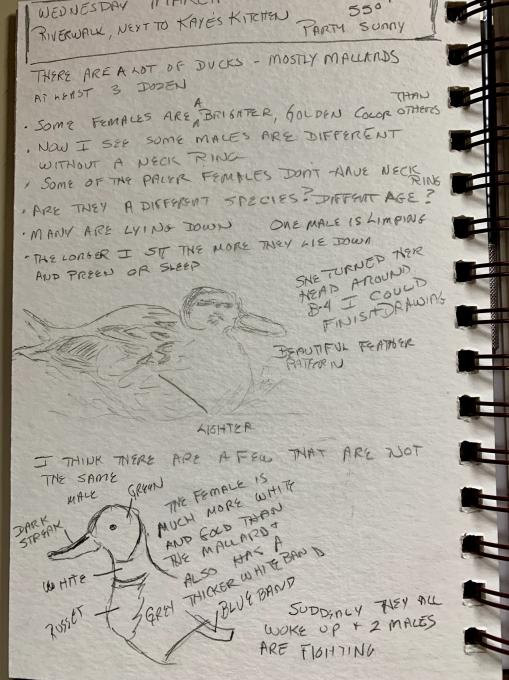
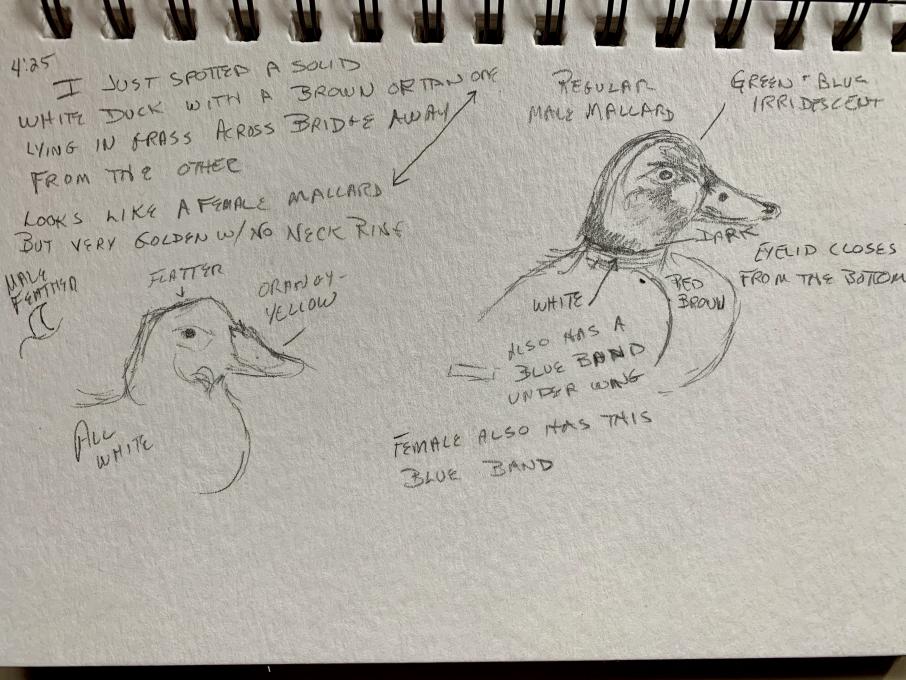
I went walking on the nearby riverwalk without know what to compare. There were 2-3 dozen mallards in one area so I thought I'd just observe them but as I did, I began to notice differences. My pare was not laid out as a comparison study because I thought I'd just be observing them!
-
This is my comparison study, holly and hemlock. I did see many differences that I might not have otherwise noted.
-
- Really nice study!
-
-
-
I went for a walk on the riverwalk nearby without knowing what I was going to see or compare. I found an area with 2-3 dozen ducks and as I watched them and took notes I started seeing differences in them. My comparison is not separated like the one in the lesson, because it started out as observations, only. I really enjoyed my time watching the ducks and would never have noticed many of the details if I had just taken photos.
-
-
I compared male and female flowers of the oak tree and found that the male flowers with their long pollen-filled clusters of flowers can lead to early spring allergies. I also compared the acorns and leaves of the northern red oak and pin oak trees.
-
I sent two comparison studies--one of the two acorns and leaf types in the northern red oak and the pin oak. The second is a comparison of the male and female flowers on a single oak tree. Oaks are monoecious and so have both male and female reproductive flowers on the same tree. It was interesting to read about this and realize that some spring allergies come from the pollen from the male flowers that will open up very soon. -- Trudy
I am not sure you got the drawings. I will add them again to this submission.
-
-
-
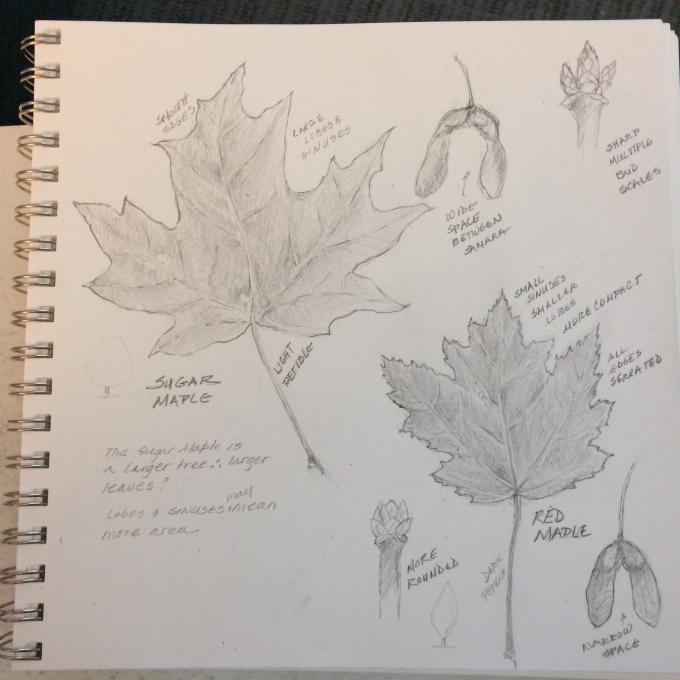
I chose to compare leaves, samara, and buds from a sugar maple and red maple. I had laminated the leaves in the fall for a children's activity so they were in good condition. I knew they were different but had not spent focused time on the ways in which they were. I noticed many differences: the larger size of the sugar maple, the smooth edges of the sugar vs the serrated edges of the red maple, the darker color of the sugar's petiole, the rounder shape of the red's buds and the spacing between each side of the samaras. Questions that were raised for me included why one leaf would have smooth edges and one toothed. Is there an advantage for photosynthesis? Does it provide a greater surface area to receive CO2? Why is one leaf smaller than the other? Does it correlate to the size of the tree? I did note the shapes of the trees in small drawing to the lower left of each leaf. The sugar maple is clearly larger in both width and height than the red maple. The sugar maple can grow to about 66' while the red maple has a maximum height of about 49'. I appreciated the focus this activity offered and the observations I was able to make. I definitely prefer to draw to help me hone my observations with writing coming in second and counting at third.
-
@Janet Hi Janet, Your leaf study is wonderful. You took something so simple and really captured the tiny details. Now I want to draw leaves!
-
-
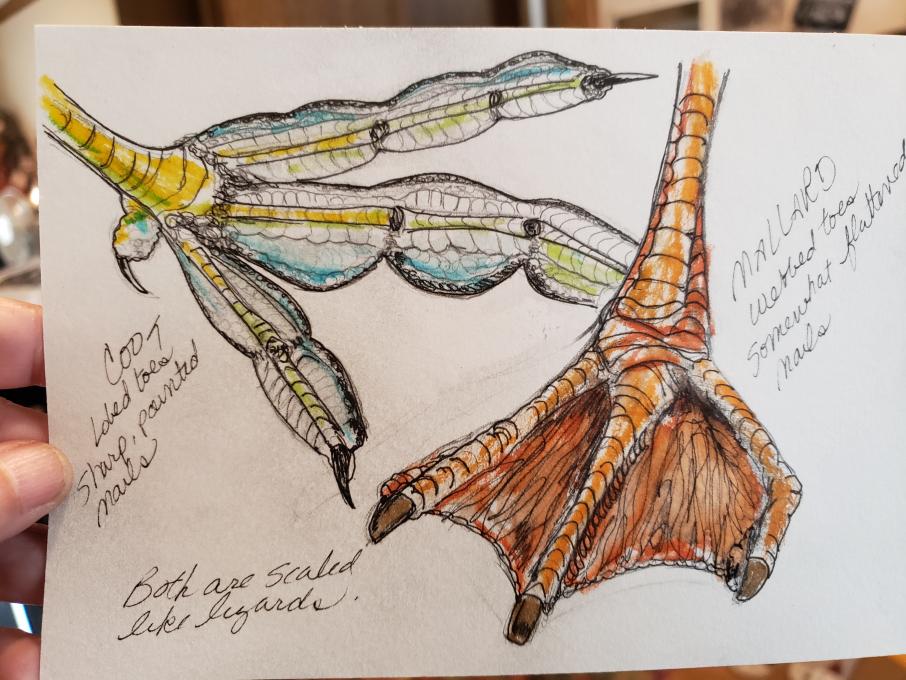
I did my comparison study on the feet of American Coots and Mallard ducks. Coots have lobed toes and very sharp toenails; Mallards have webbed feet and somewhat flat toenails. Coots legs and feet are a mix of blue gray, green, and yellow; Mallard feet and legs are various shades of orange and umber. The toe formation, webbing variance and different colors made me wonder why the birds were put together like that.
The Coots are more or less confined to marsh lands. Their lobed toes give them traction in the water when they’re swimming, but the separation between the toes also allows for more flexibility on land and walking through and over matts of marsh plants. The Coots also use their feet in dominance battles. I would assume that the light color of their legs and feet make it less likely that predators under the water could see them, and might mistake them for wafting plant frond. On land, they WALK rather than WADDLE.
I know that Mallards are the ancestors of all of the domestic duck (except the Muscovy) and they can thrive in a variety of habitats. Although they nest on ground, they spend a lot of time in the water feeding and displaying to one another. Obviously, their webbed feet make it easier to maneuver in the water while still allowing them to travel on land. The orange color, though, is suddenly interesting to me. Why such a bright and obvious color on their feet? I did a little more research on them and discovered that the color of their feet can vary depending on their age and hormone levels. The feet turn bright orange in the breeding season, signaling to others that they’re old enough and healthy enough to breed. On land, the ducks WADDLE rather than WALK.-
Bravo to a wonderful comparison of the feet and follow-up to the question it evoked! It is really too cold where I live to get out and do a comparison study but cannot wait to try my hand at it.
-
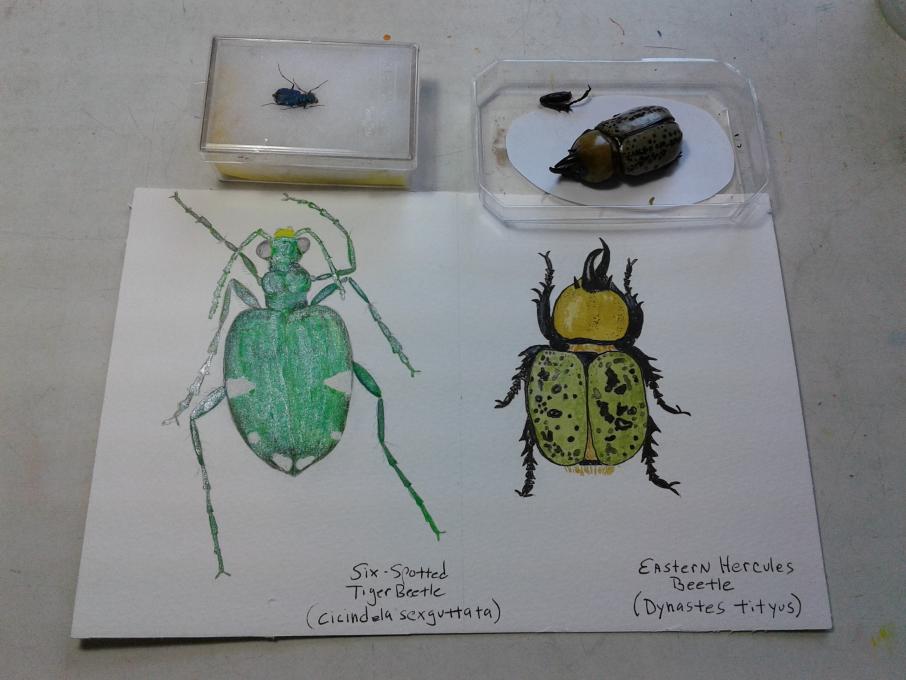 I decided to compare 2 beetles. They had more differences than similarities. I made a table with some info about them.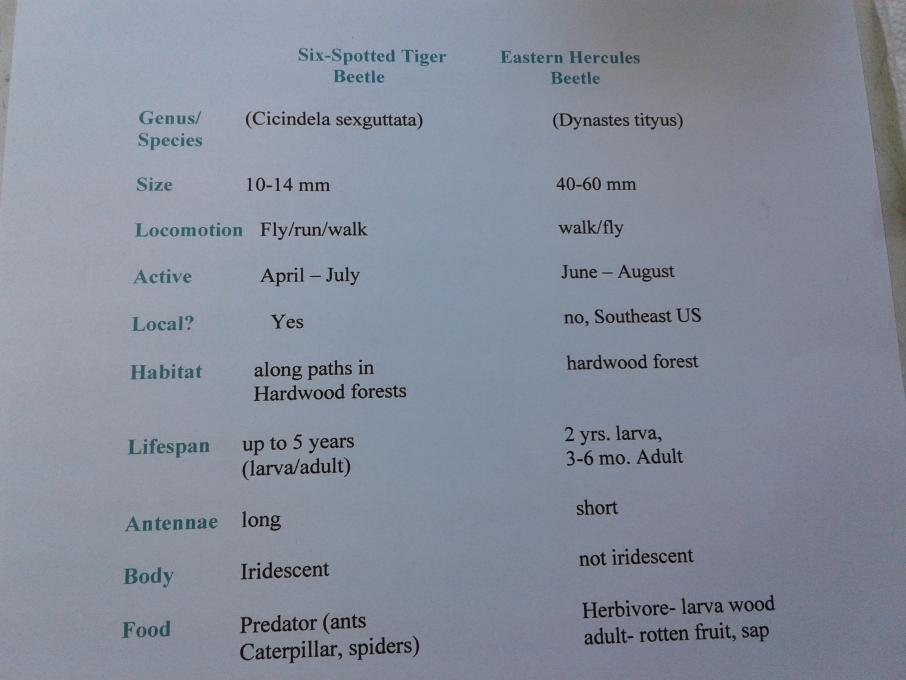
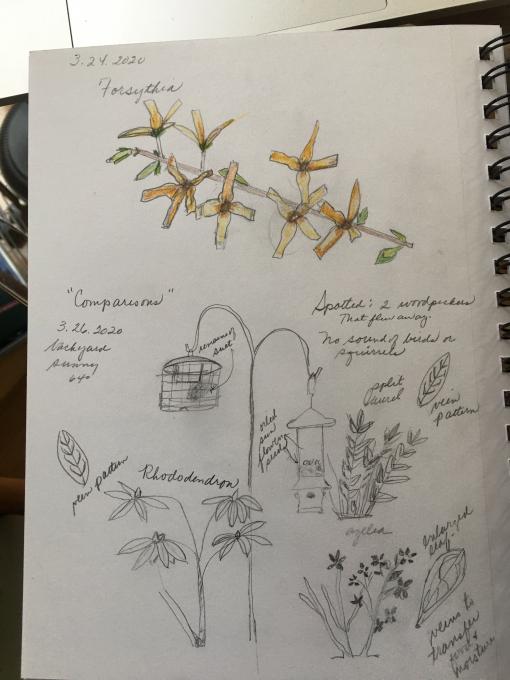 I compared the leaves of three backyard plants. The rhododendron and the laurel were very similar and symmetrical while the azalea was quite different with a rather random, but connected series of paths, suggesting that the laurel and rhododendron might be related. The actual rhodie and laurel plants themselves are quite different though and the laurel shape is more closely related to the azalea in shape with multiple stems coming from the ground rather than one or two stems rising with multiple off shoots like the rhodie.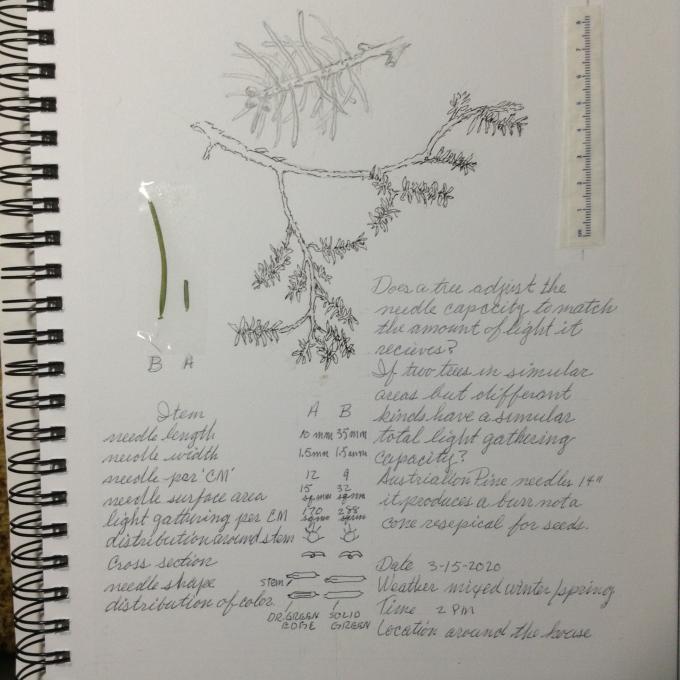
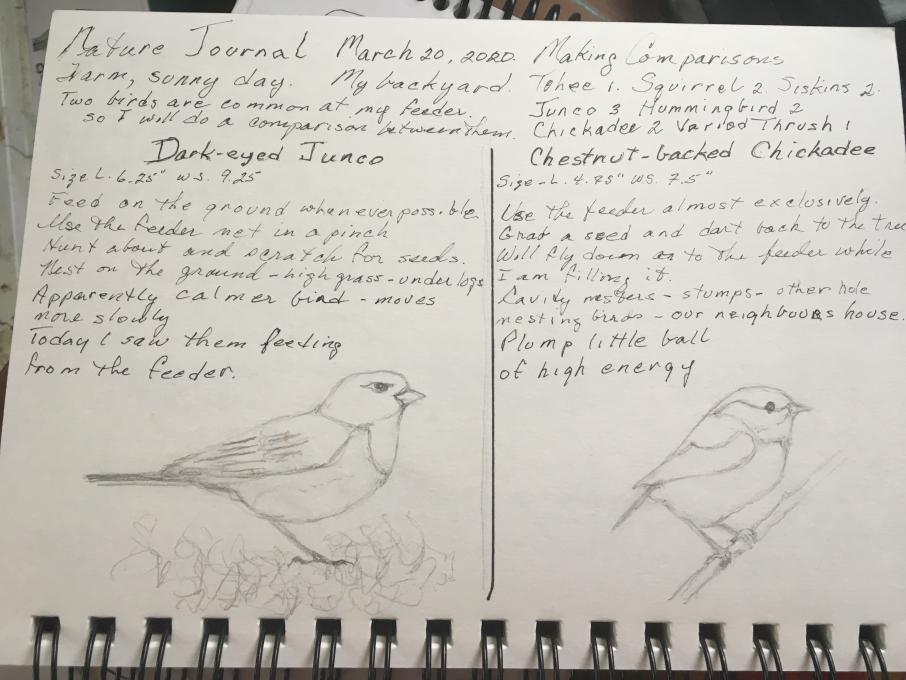 I finally completed my comparison of the Junco and Chickadee both of which frequent our feeder. I am still not drawing from the real thing - this is from the Sibley Field Guide but it did allow me to really see the differences in their form and to focus on differences in behaviour. No modelling in the drawings but maybe I will do that later. Scribbling is useful.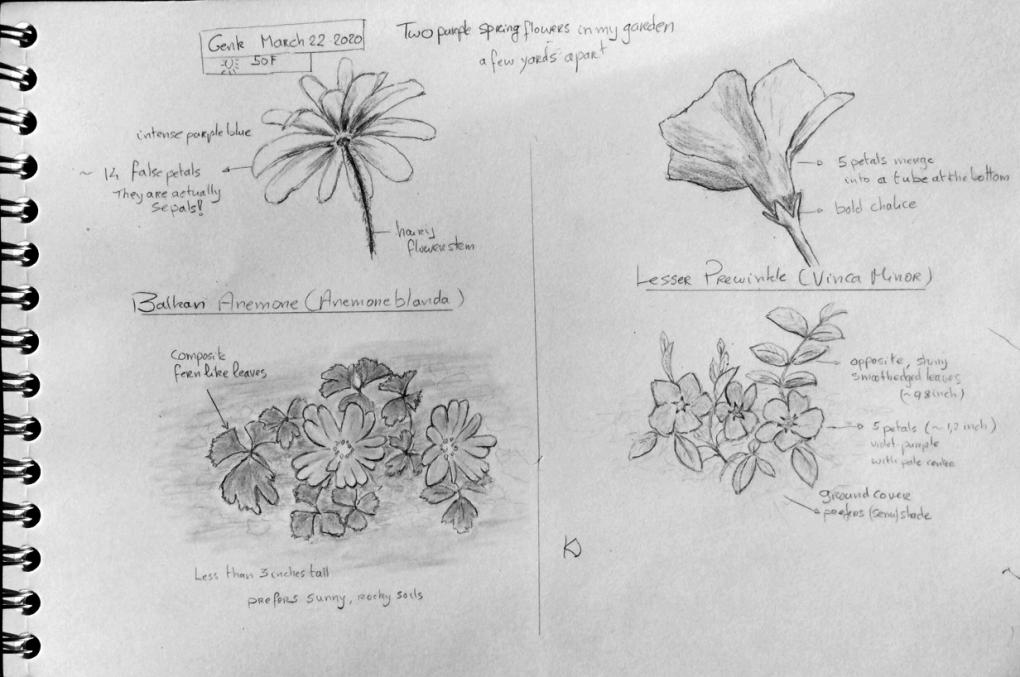
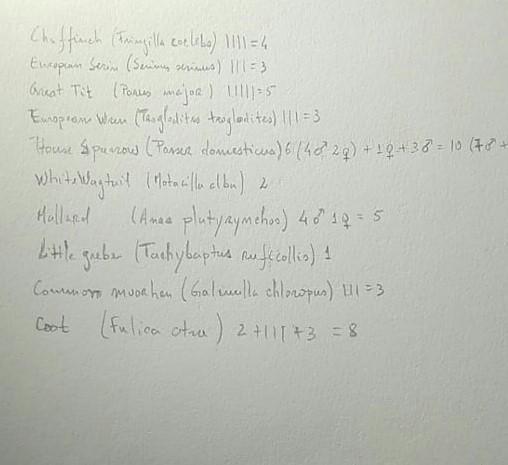 The list of birds observed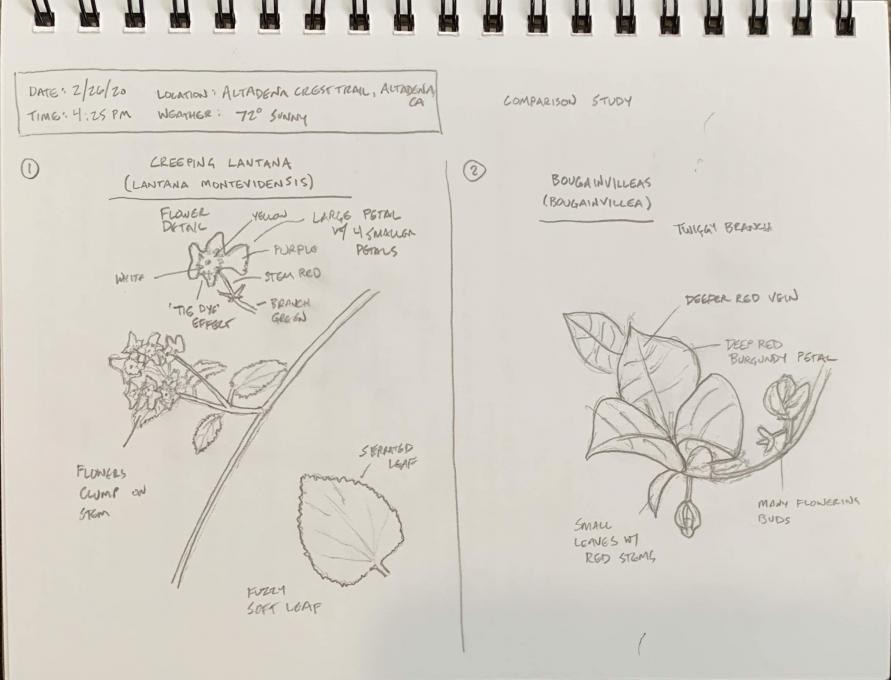
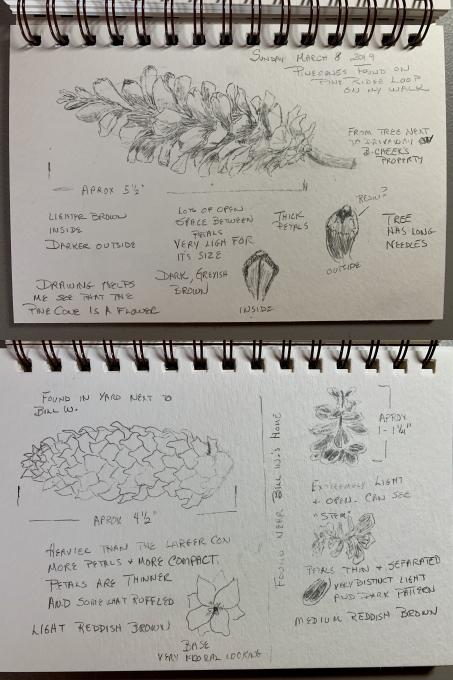
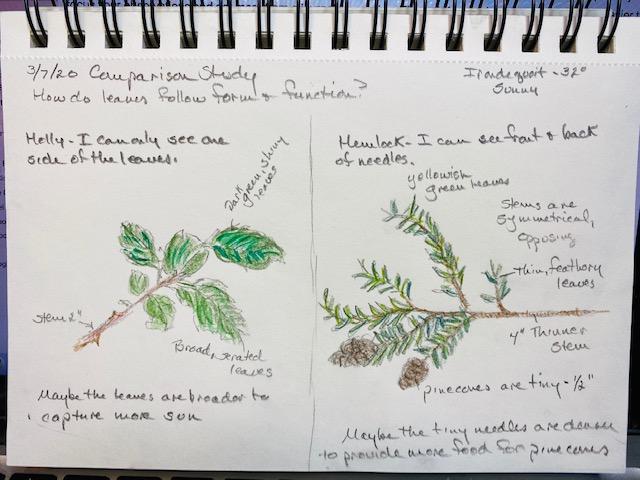 This is my comparison study, holly and hemlock. I did see many differences that I might not have otherwise noted.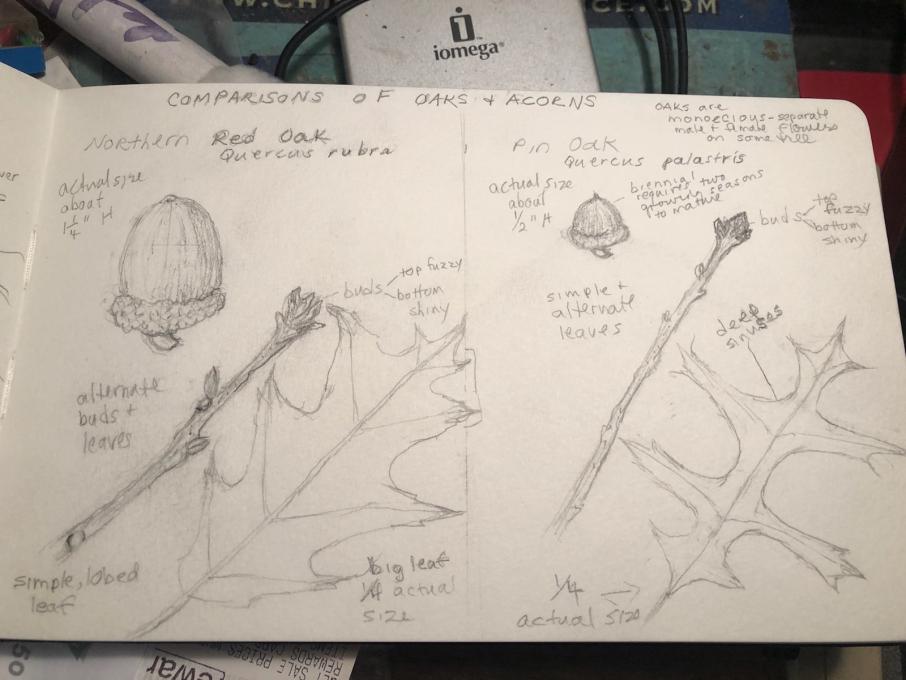
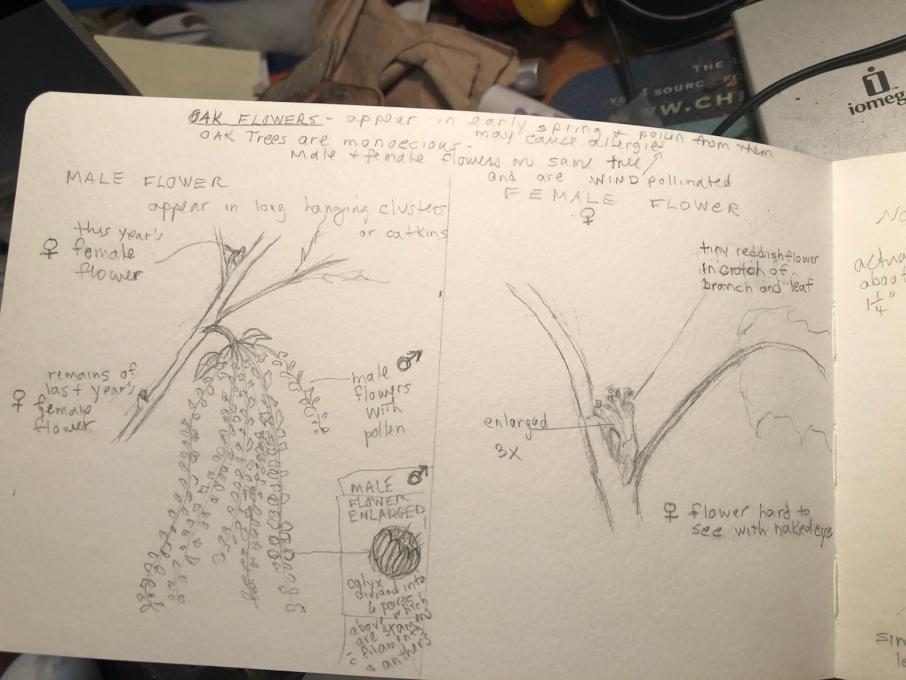
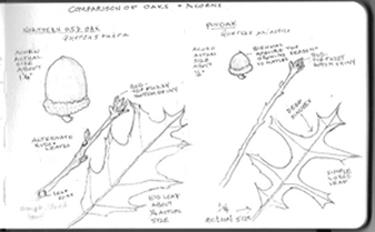
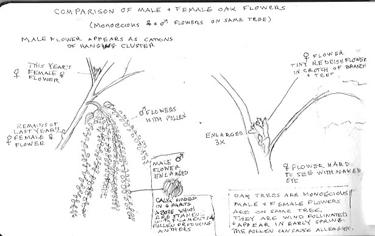
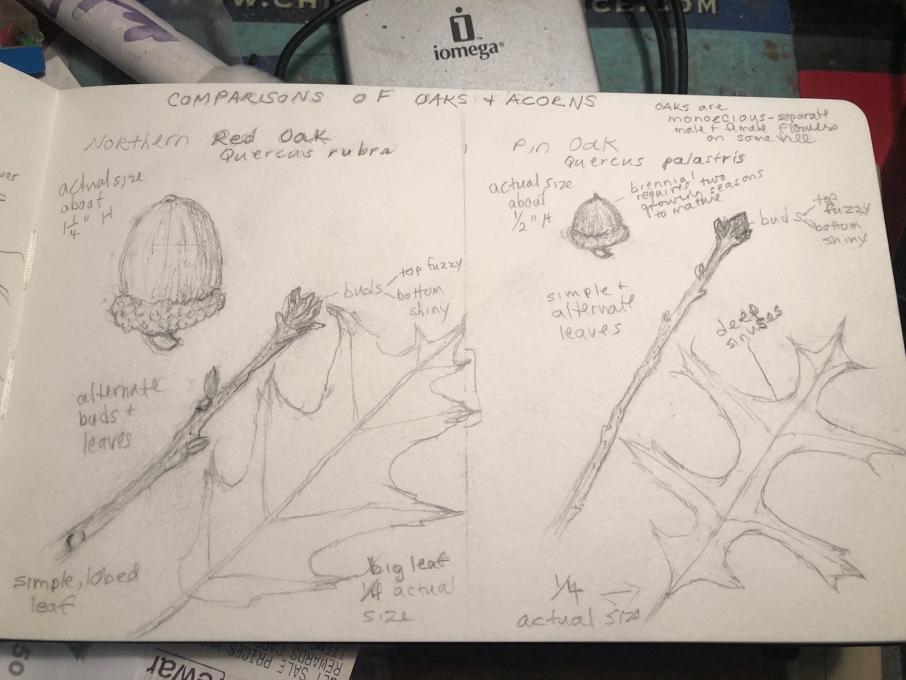
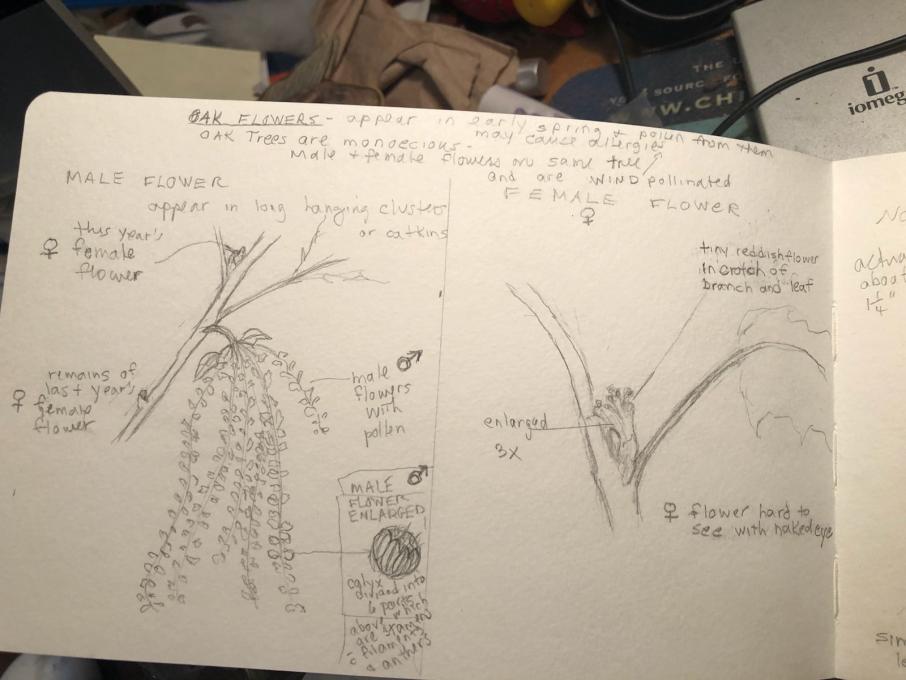 I sent two comparison studies--one of the two acorns and leaf types in the northern red oak and the pin oak. The second is a comparison of the male and female flowers on a single oak tree. Oaks are monoecious and so have both male and female reproductive flowers on the same tree. It was interesting to read about this and realize that some spring allergies come from the pollen from the male flowers that will open up very soon. -- Trudy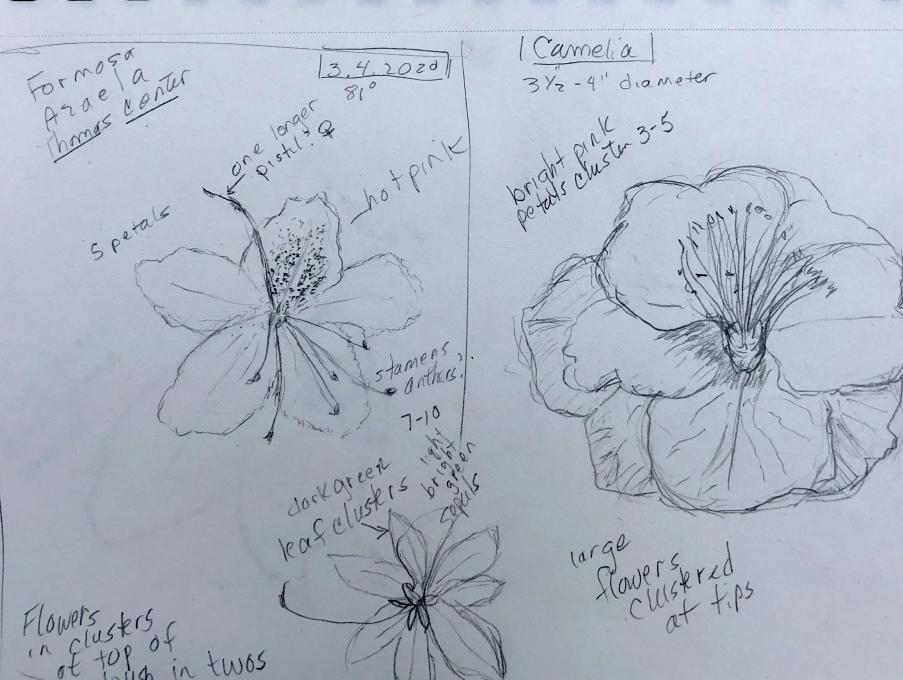
Read More: